

I feel like we all have a misconception about orca whales… I mean, we’ve all seen Free Willy, right? That movie would lead you to believe that they’re man’s best friend… right up there with dogs.
Although these magnificent creatures are massive in size, ranging from 20 to 26 feet and weighing between 6,600 to 8,800 pounds, we tend to think of them as harmless creatures that we go to watch do tricks at Sea World.
Nevertheless, we can’t forget that these beasts have the ability to rip apart even the most powerful of predators to shreds, and they don’t get the name “killer whale” for nothing.
Orcas are the ocean’s true apex predators and the largest members of the dolphin family, possessing a level of intelligence and cooperative strategy that remains unmatched in the marine world.
Orcas hunt in complex, matriarchal family pods, earning them the nickname “wolves of the sea.” And it’s a nickname that they absolutely deserve. They communicate constantly using localized dialects to orchestrate highly synchronized attacks, adapt their strategies on the fly, and teach generational hunting techniques to their young.
Different orca ecotypes have highly specialized diets. “Resident” pods typically eat only fish, specifically salmon. “Transient” pods exclusively hunt marine mammals, targeting seals, sea lions, dolphins, and even large baleen whales by separating calves from their mothers and drowning them.
Orcas manipulate their environment to secure prey. Antarctic pods swim in formation to create massive, synchronized waves that wash seals off isolated ice floes. Other pods use “carousel feeding,” blowing bubbles and flashing their white undersides to herd schools of herring into tight bait balls before slapping the fish with their tails to stun them.
However, they can be even more ferocious… sometimes attacking boats (especially around the Iberian Peninsula), but they’re also the only species that can take down the legendary great white shark.
Hunting Great Whites
When offshore orca pods target great white sharks, they do not engage in a chaotic brawl. Much like wolves, they use a highly calculated, surgical method designed to completely neutralize the shark’s defenses.
Orcas understand a critical biological glitch in shark anatomy. To neutralize a great white, an orca will ram the shark from the side or below, intentionally flipping it upside down. Being inverted instantly forces the shark into a paralyzed, catatonic state known as tonic immobility. The shark is left completely helpless and unable to fight back or swim.
Once the great white is paralyzed, the orcas do not eat the entire animal. They specifically target the shark’s massive liver, which accounts for up to a quarter of the shark’s body weight and is incredibly rich in squalene (a high-energy fatty compound). The orcas make a precise, surgical tear near the shark’s pectoral fins and squeeze the intact liver out of the body like toothpaste from a tube, leaving the rest of the carcass to sink to the ocean floor.
With that being said, here’s a look at this methodical hunting strategy. Alison Towner, a scientist based out of South Africa, has been studying the movements of great whites for quite some time now, over 15 years in the field.
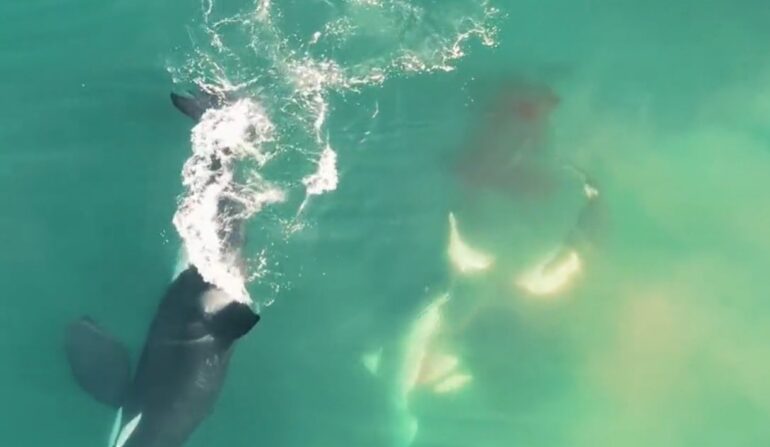
She recently captured wild drone footage of a great white getting mauled by an orca, as two other orcas surround the lone shark.
She has some bold claims about the video:
“It’s probably one of the most beautiful pieces of natural history ever filmed. I really do think once that footage airs, it’s going to go viral. The whole world is going into a frenzy about it because it’s just so unique.
We’ve had all the evidence for killer whales being responsible for killing white sharks. But this is the world’s first drone footage of killer whales predating on a white shark. It’s the first time in South Africa it’s ever been documented as direct evidence.”
Going viral? She was right…
She explains that the orcas are eating the great white’s liver, as she noted that several carcasses have shown the liver missing. It was something researchers knew, but never really seen play out in the wild.
Check it out: