

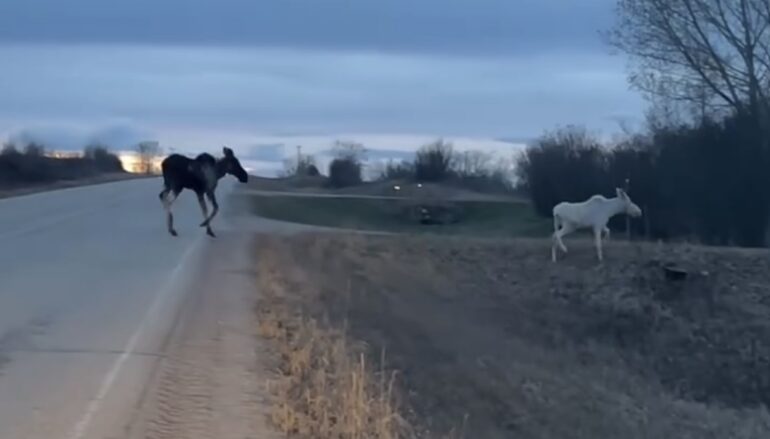
Nothing like a two-for-one rare moose sighting out in the wild.
Nature is a brutal place, but it can also be a beautiful one. Often times, the outdoors content that gets the most views are predator versus prey, or some sort of fight for survival. In this video, the action isn’t the main focus. Instead, it’s the two animals themselves – and their existence – that makes this footage must-see.
A couple of years back, a storm chaser named Tree Tanner was driving around in Canada when they spotted some out of the ordinary. Seeing a fully grown moose out in the wild is special as is… but seeing both an all-white and piebald moose walking around together? That’s what you call a once-in-a-lifetime experience.
What gives a white moose its rare color? It’s one of two things: albinism or leucism.
Albinism is caused by a genetic mutation that prevents the production of melanin, the pigment responsible for coloration in skin, hair, and eyes. Albino animals typically have completely white or pale skin, fur, or scales, with red or pink eyes due to the lack of pigment in the iris, allowing blood vessels to show through. It affects all melanin-producing cells, meaning patterns and markings are completely absent.
Leucism on the other hand is caused by a different genetic mutation that results in partial or complete loss of pigment in the skin, feathers, fur, or scales. Unlike albinism, leucistic animals can still produce melanin in their eyes, so they often have normal-colored eyes (blue, brown, black, etc.) rather than red or pink. Patterns and markings may still be visible, appearing faded or muted rather than completely absent. It’s more common in birds, reptiles, and some mammals like deer or big cats.
Piebaldism, which one of the moose in the video seems to have, is actually a form of partial leucism.
And just to be clear, the odds of witnessing one of nature’s beautiful mistakes are slim to none. Albinism is a recessive genetic trait, meaning that both parents of the albino offspring must carry the trait. In the rare case that the pair both have the non-dominant trait, they can then pass it down to their baby and cause it to have a lack in hair, tissue and skin coloration. When it comes to moose, there’s about a one in 20,000 chance that they can be born albino. Both instances are extremely rare in the wild. However, leucism is slightly more common at around one in 10,000.
But I don’t know exactly how the math works when you see a white moose and a piebald moose together. This storm chaser was out looking for weather and instead found an astounding case of nature’s accidental beauty in motion. Seeing one or the other would be special. Seeing both at the same time? That’s almost unheard of. Fortunately for the rest of us, Tanner was able to get it all on video, and though it’s not action-packed… it’s a sight to see:
“Spirit moose and her twin crossing the road in front of us last night.”