

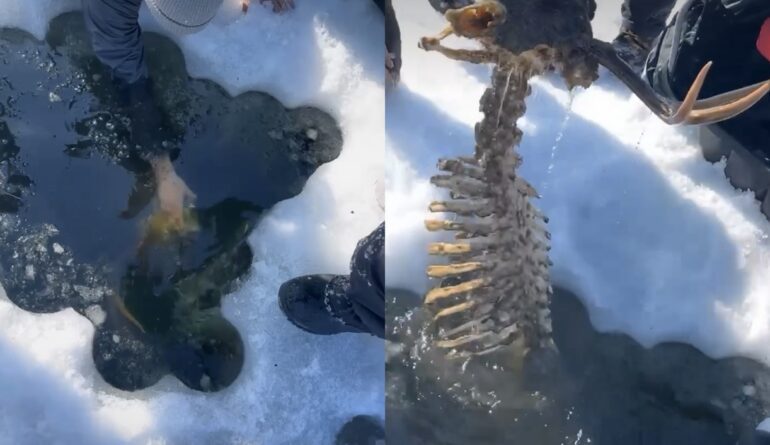
I’m confused…is this a hunting story or a fishing story?
Considering that a guy technically laid out a big buck, it could be categorized as hunting. But then again, he did have to reel in the deer, or what used to be a deer, out of the bottom of a body of water, so that’s more along the lines of fishing.
How about we just move forward and say it’s a little bit of both, shall we? Admittedly, it’s without a doubt an ice fishing story, and a crazy one at that. Deer skeletons don’t get hooked like this all that often.
Of course, catching a deer skeleton through the ice is the unlikely result of a tragic winter accident…
How Does This Happen?
Deer, elk, and moose frequently use frozen lakes as open travel corridors during the winter to avoid deep snowpack in the woods. When they hit a thin patch, perhaps early in the season, or even a thermal spring, they break through. Unable to climb back out onto the slippery ice, they drown and sink to the lake floor. Over months or years, aquatic scavengers and water pressure strip the soft tissue, leaving a skeletal frame on the bottom.
Ice anglers targeting deeper-water, bottom-dwelling species like lake trout or walleye will drop jigs or live-bait rigs directly to the lake floor, or perhaps just a few inches off. If they happen to drill their hole directly above a sunken carcass, it is actually pretty easy for a hook to drag across the bottom and firmly lodge itself inside a ribcage, a spinal column, or a rack of antlers. Have you ever hooked a branch on the bottom? Works the same way…
I’m not entirely sure what kind of line and tackle these fishermen are using, but I generally use braid on my rods and on my tip-ups… especially if you have toothy critters like pike in your waters. Anglers hunting big fish in deep water will generally use braided fishing line (often 20- to 50-pound test) and stiffer ice rods.
Of course, here is the main problem… standard ice fishing holes are typically only 8 to 10 inches in diameter. There’s just no way to get a skull, let alone the entire skeleton, through your standard ice hole. However, this angler had a bunch drilled next to each other, which makes for a pretty big space to pull large fish through. And, a big space to release them into. This allowed the angler to pull up a skull, a rack of antlers, or a tangled string of vertebrae straight up through the hole.
These particular ice fishermen were somewhere in Alberta, Canada, and at first, they thought that they were lucky enough to have hooked the skull and antlers of a deceased deer. The fishermen got even more hype as they pulled out the skull to reveal that most of the rest of the body, including the back legs, were still intact as well.
There’s probably nothing else that they could have reeled in that would have thrilled them more than this deer skeleton.
Normally you’d be disappointed if you pulled up something out of the water that wasn’t a fish, but this is one of those rare circumstances where catching a deer carcass is equally (if not more) exciting.
However, like I mentioned, there are a lot of people in the comment section that are concerned about pulling a spooky skeleton out of the deep waters:
“That’s one effed up looking fish.”
“Put it back down there. PUT IT BACK.”
“Why do I never get to find these cool things?”
“Well there went their deer tag for the year.”
“Bros just unleashed the ancient curse.”
The good news is that if there was a curse attached to this deer skeleton, this post was celebrating the one year anniversary of the catch. Surely the curse would have kicked in by now, right… RIGHT?