

Eye on the prize, don’t lose focus, buddy.
North American elk are one of the largest species within the deer family and a true icon of the American wilderness. While they once roamed freely across nearly the entire continent, European settlement, unregulated market hunting, and habitat loss in the 1800s nearly wiped them out. But thanks to massive conservation efforts, the U.S. elk population is thriving right now, numbering over one million.
While they are primarily concentrated in the vast public lands of the Western United States such as Colorado, Wyoming, Montana, and Idaho, highly successful reintroduction programs have established healthy, growing herds in eastern states like Kentucky, Tennessee, Pennsylvania, and Michigan. Even in my home state of Wisconsin, not exactly a state known for elk, we now have an elk season with a very limited number of tags available.
Elk In Utah
Utah boasts one of the most robust and heavily managed elk herds in the country, with a statewide population currently hovering around 80,000 animals.
In the hunting and conservation world, Utah is famous for producing absolute giants. The state manages many of its hunting units (such as the Pahvant, San Juan, and Monroe units) strictly for trophy quality, allowing bulls to reach full maturity (6 to 8 years old). Because of this, Utah consistently produces some of the largest, record-book Rocky Mountain elk in the world.
And it makes sense… Utah’s geography is perfectly suited for elk. They spend their summers in the high-elevation aspen and conifer forests of the Wasatch and Uinta mountains, utilizing the dense cover and rich, high-protein forage.
Elk Migration
Elk are highly nomadic and rely on seasonal migrations to survive the harsh western environment. They travel in large herds, typically led by a dominant, older female known as the “lead cow,” who relies on generational knowledge to navigate ancient migration corridors.
During the spring and summer, herds push high up into the alpine basins and mountain peaks. The cooler temperatures keep biting insects at bay, and the lush, high-altitude vegetation provides the massive amount of calories needed for cows to nurse calves and for bulls to grow their massive antlers.
When the heavy snows arrive in late fall, the deep powder makes it impossible to find food and evade predators. The herds are forced to migrate miles out of the mountains and down into the lower-elevation valleys, sagebrush flats, and agricultural fields to ride out the winter.
You might think that the primary threat to elk are predators or hunting, but that would be wrong… it is actually habitat fragmentation. The migration routes they have used for thousands of years are increasingly being severed by human expansion.
As the western U.S. population booms, the lower-elevation valleys that elk rely on to survive the winter are rapidly being converted into subdivisions, highways, and commercial real estate. This unfortunately means more run-ins with humans.
Elk are massive animals (bulls can weigh up to 800 pounds). When their migration corridors force them to cross high-speed interstates and busy highways, the resulting vehicle collisions are highly dangerous for drivers and devastating to the local herds.
Struggle With Fences
Because human infrastructure has cut directly through their habitat, migrating elk are forced to navigate endless miles of agricultural and residential fencing. While an adult elk is incredibly athletic and can easily clear a standard four-foot barbed wire fence, these barriers remain highly lethal.
The most common and tragic fence accident occurs when an elk misjudges the jump or slips on icy ground during takeoff. As they clear the fence, their heavy hind legs can easily drop and get caught between the top two strands of barbed wire. The forward momentum twists the wires together, firmly locking the animal’s legs in a snare.
Once suspended upside down or pinned to the fence, the elk cannot free itself. It will violently thrash until it completely exhausts itself, eventually dying from hypothermia, stress, or predation by coyotes and wolves.
Even if the adults make the jump, standard woven-wire “sheep fences” act as impenetrable walls for newborn and juvenile calves. Unable to jump the fence or squeeze through the tight wire mesh, calves are frequently separated from their mothers and left behind to starve or be picked off by predators.
To combat this, western wildlife agencies heavily promote “wildlife-friendly fencing,” which involves using a smooth wire on the bottom (so antelope and calves can scoot under) and lowering the top wire while widening the gap between the top two strands to prevent the fatal leg tangles.
In this video here, we’ll see exactly how and why fencing can be so dangerous for these big bulls.
This big lad certainly knew what he wanted, it just so happened that paying attention might have helped get him to her faster. Elk, deer and the various deer-family species are pretty cool to watch, especially when it comes to the rut. They just act so different, and much more aggressive with only one thing on their minds.
Just like a frat boy at the bars, they’re looking to meet women, and they’re even willing to fight over them. I mean, can you imagine if humans only got a short period of time once a year to be able to mate? It would be a few weeks of pure anarchy that would inevitably turn violent.
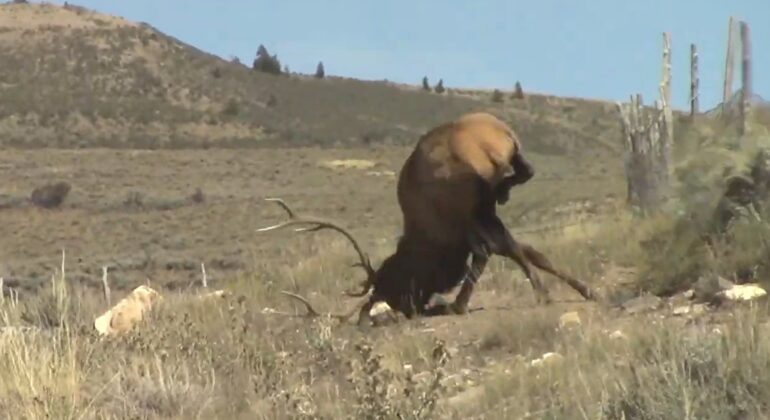
This bull elk out in Utah was on a mission to get some loving from a cow when he came across a fence. We’ve seen animals struggle to jump over things before but there’s just something hilarious about a big ol’ bull chasing a cow and running into something.
This bull jumps the fence, gets tangled up, and does a full front flip on the other side. Without missing a beat his eyes are back on the prize and he’s off as if nothing happened. Luckily for him, the only injury he suffered was to his ego, but then again, I don’t think ek get embarrassed… it was right back to business with that cow.
According to the man filming, the bull just carried on, in full pursuit:
“This big guy was so focused on chasing a cow elk, he didn’t notice Biologist Brian Maxfield in his truck nearby, or the fence. The bull continued chasing the cow, acting like nothing happened. Way to recover, buddy.”
I’ve seen this one before, the hard wipe out, and then play it off cool to make sure the lady is still into it… happens to the best of us.
However, not all are this lucky…
Bull Elk Mistimes Jump
What a sad sight to see.
Something so gorgeous just absolutely eating it and paying the ultimate price for a simple miscalculation…
This is as crazy as it gets, one of those moments you can’t believe you happened to catch on video. You’re filming something spectacular but fairly common in that of an elk herd running across the countryside when the completely unexpected happens.
Elk are amazing animals, which is why this is so heartbreaking. They can weigh up over 1000-pounds, have antlers like no other and are widely known as the tastiest wild game around. I mean, if you’ve ever bitten into a tender elk backstrap, you know just how magnificent these beasts are.
Their bugle is world-renowned in the outdoors world… one of the coolest noises you can hear in the woods.
A herd of elk is shown running across the fields of what appears to be the American West, perhaps Colorado, Wyoming or Montana. After a bunch of cows make the jump over a fence in pans over to a nice bull running full tilt towards it.
The bull gets to the fence and makes a fairly pathetic jump. It’s back legs get hung up as he is flung forward flipping over. To make matters worse his antlers get lodged into the ground causing his neck to bend very awkwardly.
Utter shock at what we just witnessed…
The elk lays on its back kicking for its life, it kicks and kicks but doesn’t get flipped over. Very quickly it slows its movements down. The initial “he just broke his neck” thoughts are spot on here. The video ends showing a close-up picture of this gorgeous 6×7 bull that had an extremely unfortunate end to its life.
I mean, what a painful and humbling reminder of how fragile life can be. You evade hunters, vehicles, predators, starvation, climate… everything that can kill an elk, only to get hung up on a fence, trip, and die.
The tragedy of life on full display.