

Fire up the stills.
Well, maybe not quite yet, but the Supreme Court just announced a major decision that could clear the way for home distilling for the first time since the 1800s.
For decades it’s been legal to make homemade wine (shoutout Creole Williams) or beer for personal consumption, as long as you’re not planning on selling it. But for the pasts 150 years, making spirits at home has been strictly off limits.
The ban goes back to 1868, and as with pretty much everything else, it all comes back to money. The current law prohibiting the home distilling of spirits was enacted in order to crack down on tax evasion from people who were making their own liquor at home. Basically, the government was losing out on money because people were making whiskey instead of buying it, so they just banned making it at home.
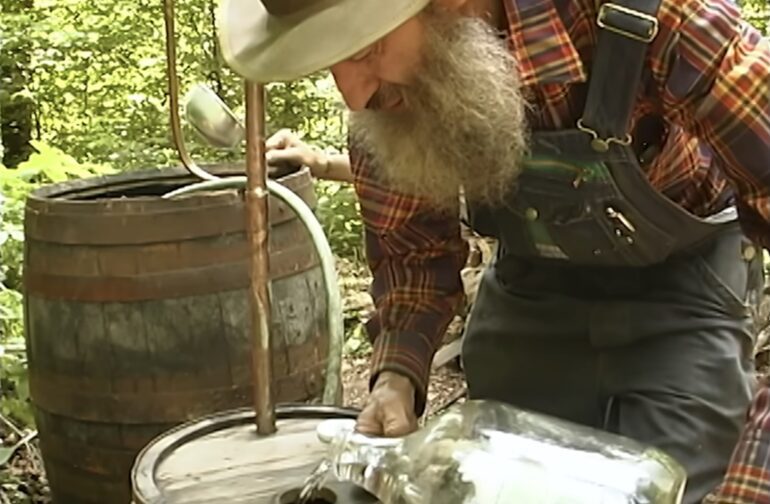
Several states have legalized home distilling in recent years, including Arizona, Massachusetts, Missouri and West Virginia, though laws vary by state as to how much moonshine you’re actually allowed to make (and some states still ban possession, while others have laws that vary by county). But under the current federal tax code, distilling spirits at home or even possessing an unregistered still is still illegal and classified as a felony punishable by up to 5 years in prison and up to a $10,000 fine, or both.
But recently there have been several challenges to the law, claiming that Congress exceed its power under the Commerce Clause when they banned distilling alcohol for personal use and asking courts to strike down the 1868 law.
One case in Texas involves the Hobby Distillers Association, which sued on behalf of two of its members after being told they weren’t able to obtain permits to distill at home due to the federal ban. In that case, the 5th Circuit Court of Appeals ruled that the ban is unconstitutional, finding that Congress had exceeded its power to collect taxes on alcohol by banning home distilling.
In a separate case though, the 6th Circuit Court of Appeals ruled against a would-be distiller in Ohio, finding that the ban is a “necessary and proper” exercise of Congress’s power and is therefore constitutional.
Because the courts were split, the Supreme Court agreed today to take up the case to resolve the issue, with the Department of Justice asking the court to review the Texas case to determine the extent of Congress’ power to regulate “local, noncommercial conduct.”
Now, I don’t really want to get too much into case law on the Commerce Clause, because most of it just makes me mad, but the argument from those challenging the law is that the Constitution gives Congress the power to regulate “interstate commerce” – which is, obviously, commerce between the states. And these distillers simply want to distill spirits at home for personal use, not sell it, so there’s no way that should be considered “interstate commerce,” or even commerce for that matter.
But the Supreme Court ruled in the past (in one of their worst rulings of all time) that a farmer growing wheat on his own property for his own family to eat was “interstate commerce” because, in their view, if everybody just grew their own wheat it would have an effect on interstate commerce. Seems like a massive stretch, but that’s the law right now, and it’s been used over and over to uphold laws on everything from medical marijuana to the Affordable Care Act (although the Supreme Court DID rule that carrying a handgun isn’t interstate commerce, so at least there’s that).
Anyway, I’ve gotten too much into the case law, because the main point here is that the Supreme Court could soon overturn a nearly 160-year-old ban on making moonshine at home for personal use.
Of course that doesn’t mean that everybody will be able to immediately start making their own whiskey: States could still have their own laws regulating distilling, and Congress could find another way to regulate it that would pass whatever test the Supreme Court decides to use to examine the law.
But if you’re somebody who wants to make your own moonshine (because nobody does it now since it’s illegal, obviously) there’s hope that the Supreme Court might clear the way soon enough.