

Believe it or not, “Panama” actually translates to “abundance of fish” or “many fish” in several indigenous languages, and when it comes to the offshore sport fishing world, it couldn’t be more accurate. You have top tier yellowfin tuna, wahoo, dorado, roosterfish, sailfish and more. But for anglers chasing one of the most sought after fish anywhere in the world, the magnificent marlin, Panama is widely considered a global mecca.
The country’s Pacific coast offers an unparalleled combination of underwater geography, warm currents, and strict conservation practices that create one of the most prolific billfish habitats on earth.
Locations like the Hannibal Bank in the Gulf of Chiriquí and the legendary Piñas Bay to the south feature massive underwater mountains and sharp drop-offs. These submerged cliffs force deep, nutrient-rich ocean currents to the surface. This upwelling creates an explosive food chain reaction, attracting massive schools of skipjack tuna and yellowfin, which in turn draw the apex predators. Because of these sharp drops, it is not uncommon for anglers to hook into monster marlin just a few miles offshore, a luxury rarely found in other global fishing destinations.
Black & Blue Marlin
When it comes to the marlin themselves, Panama is particularly famous for its black marlin. Blue marlin generally prefer to hunt in the deep, open ocean, whereas black marlin are structure-oriented. They actively patrol the rocky reefs and underwater seamounts of the Hannibal Bank, using their immense power to ambush prey. Catching a black marlin in the 500-to-800-pound range is a daily possibility during the peak season, and “granders” (marlin weighing over 1,000 pounds) are always a looming threat.
Blue marlin are also incredibly abundant, typically found just a little further offshore in the deeper blue water, while striped marlin make seasonal appearances as the water temperatures shift. The preferred local tactic for targeting these giants is slow-trolling massive live baits. Crews will often bridle a live five-pound bonito or small tuna to a circle hook and pull it slowly over the reefs, waiting to coax a violent, topwater strike from a massive billfish.
If you want to book a trip, it’s gonna be costly, very costly… but that’s the price you pay for world class marlin fishing. But marlin fishing from a kayak? Well, that’s a whole different kind of beast.
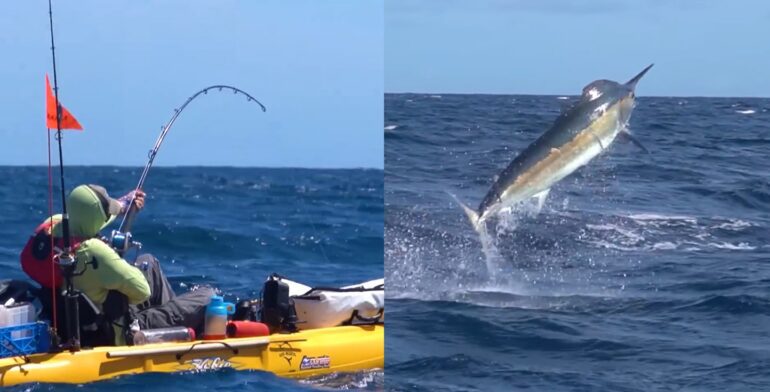
Adam Fisk is a saltwater kayak fishing specialist who guided around Panama, Alaska and Florida. So if anyone is going to be kayak fishing for massive marlin, it’s gonna be this dude. Of course, when you get a day off as a guide, which isn’t all that common depending on where you’re guiding, what else are you gonna do but try and get on some bigs yourself. And that’s exactly what he was doing near the Los Buzos Resort on the Pacific Coast of Panama a few years back.
Using a blue runner as bait, Adam hooks into a big black marlin and immediately radios for a boat to help… he’s in for the fight of a lifetime over the next handful of hours, and he knows it. The excitement is unbearable, but he’s got a long battle ahead of him. Some of his buddies get a boat to follow next to him in case he needs any help, but for the next few hours, you’re just trying to tire it out. The marlin is peeling line, and you’re just holding on… along for the ride.
After a while, over 4 hours of fighting and a dozen miles off shore, the fellas start to get a sense that this marlin is fighting too hard for its own safety, and Adam hops into the boat to try and speed up the retrieval. After more than 6 hours of fighting and being towed 15 miles out to sea, they finally get the 500-pound black marlin to the boat and are able to get the hook out (maybe the line broke?) and release it. An unofficial kayak world record.
As some who kayak fishes for bass regularly, I can’t even fathom this kind of experience. You can get tossed around pretty good in the waves of some local boat traffic, I can’t imagine what’s it’s like to fish for targets far larger than the boat your on, in water that’s plenty deep and rough… this isn’t exactly my idea of a relaxing day of fishing, but an exhilarating one nonetheless.
Gotta be a bucket-list type of excursion for most of us… I think I’ll add it to the list.
Panama’s Approach To Conservation
After all that work, why just let it go? Well, because you have to…
What truly preserves Panama’s reputation as a premier marlin capital is the country’s dedication to conservation. Panama has strict regulations protecting billfish from commercial exploitation, effectively banning commercial longlining and purse seining within a massive radius of the coastline.
Furthermore, the entire sport fishing fleet operates on a strict, legally mandated catch-and-release basis for all billfish. The universal use of circle hooks ensures that the fish are hooked safely in the corner of the jaw rather than deep in the stomach. Anglers learn exactly how to leave the fish in the water alongside the boat for a quick photo and revival, how to remove the hook and revive the fish, and allow these magnificent giants to swim away healthy.
A once in a lifetime catch… are you not entertained?