

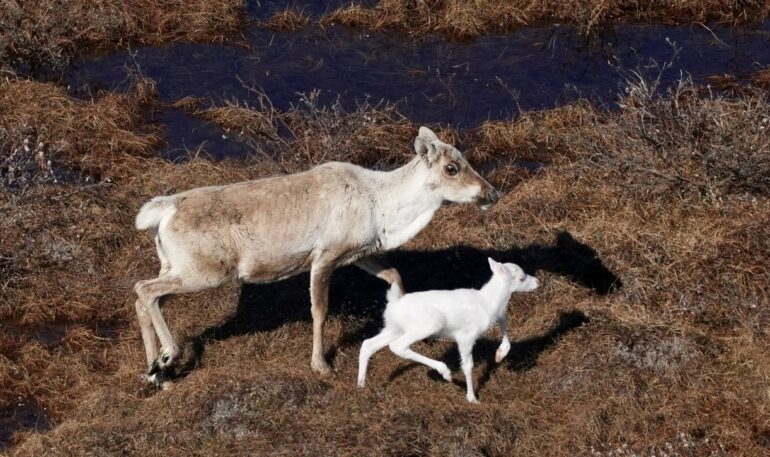
An albino caribou was recently sighted in Alaska, and it’s yet another example of the beauty that nature provides.
Alaska Department of Fish and Game biologist, Jordan Pruszenski, was out doing seasonal caribou calf counting when something stuck out like a sore thumb from the the landscape. According to Alaska Public Media, the biologist wasn’t sure what she was seeing at first. But as she got closer, it was clear that she was witness to an incredibly rare, albino caribou.
The odds of witnessing one of nature’s beautiful mistakes are slim to none. It’s one of those situations where if you see an albino animal, you go and buy a lottery ticket right after (though you kind of already won the lottery seeing the rare creature in person).
Leucistic mammals, which is a partial loss of pigmentation that usually results in white fur but regular eyes and hooves, are slightly more common, but it’s estimated that only one in every 30,000 caribou that are born are albino. For clarification, those aren’t very good odds, and one could argue that the odds of catching a glimpse of one only get slimmer and slimmer the older the creature gets. Obviously, an all white caribou is going to stick out like a sore thumb in the habitats that they usually call home, which makes them more prone to being attacked.
Which is a real shame, because that just means that the albino animal is fighting against the odds for its entire life. Before they are even born, a “perfect storm” of parents is needed to create the all white caribou. Albinism is a recessive genetic trait (having flashbacks to biology class?), meaning that both parents of the albino offspring must carry the trait. In the rare case that the pair both have the non-dominant trait, they can then pass it down to their baby and cause it to have a lack in hair, tissue and skin coloration.
As I stated earlier, an albino caribou’s color alone leave them with tough odds for survival, and that’s before you add in that caribou that are born with albinism often also have physical deformities and abnormalities. Spine issues, shortened legs, deformed hooves, shortened jaws, and severe immune issues attribute to the typical short lifespan of albino caribou. The only real thing these white deer have going for them is a) they do have great camouflage in the snow (obviously) and b) Native Americans believed they were enchanted beasts, were symbols of peace and had sacred significance.
There’s no doubt that this caribou is magical. Albino caribou have only ever been spotted in Alaska around 9 to 10 times in the state’s official records. The last came in 1976, but no photo was captured:
“The last record Fish and Game has is from 1976, when someone watched an albino calf from the Porcupine Herd through a spotting scope for about two minutes.”
Here’s the photo Jordan Pruszenski was able to capture a couple of months ago:
What a beaut.
As far as next steps go for this albino caribou, the Alaska Department of Fish and Game says they did not collar the calf or the mother, and don’t plan to. Pruszenski says they are going to wish for the best for the little one, and hope that it survives and overcomes any health issue it may have.
They also hope to see it again at some point, and ask for others to let them know if they do:
“If you happen to see it, it’d be great to let us know. But what we don’t really want is people to really be sort of trying to bother this caribou. We want to be able to give it its best shot, which will be to kind of just let it be a normal caribou.”