

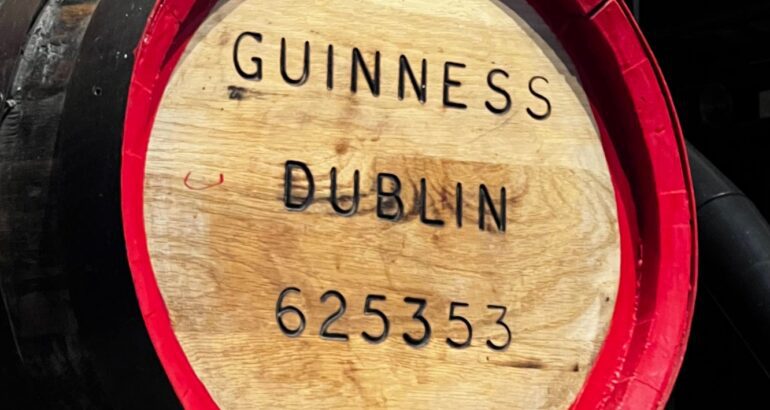
Beer drinkers rejoice… thanks to a shipwreck discovery, the world could soon get a taste of 1800s era Guinness.
Stefan Panis, an expedition diver and underwater photographer, and Paweł Truszynski, a research diver and historical researcher, are working on one of the most important scientific projects in the history of the world (in my opinion). They recently dove down to the shipwreck of The Mindora – a ship that had set sail on November 27th, 1864 and collided with another vessel – and they found beer’s holy grail.
Panis said they saw countless bottles in the shipwreck, and decided to pick one out of the former cargo ship. The diver told the Irish Times they were stunned to see the inscription on the bottle, and believe there are even more:
“We lifted the artifact, and then on the surface a quick rinse revealed ‘Guinness’. Seeing the size of the case, I think it is definitely a case of 24 bottles. But there might be more cases.”
How about that?
What makes it even better is that the aged bottles of Guinness just so happened to be resting in perfect preservation conditions – around 4 degrees, absolute darkness at the bottom of the sea, and constant high pressure. Panis believes those perfect conditions could allow for a re-brew of that 1800s era Guinness:
“There is always a chance that we can recover the complete DNA, and then we can do a small re-brew of the exact beer that was found in the 1860s.”
For those wondering, it’s not like Guinness suddenly lost their stout recipe in the late 1800s. Instead, it was the British Free Mash Tun Act that relaxed taxation on malts and beer, and thus prompted the world-renowned brewery to modify their recipe a bit moving forward.
And with these bottles that have been discovered, it’s the yeast within – or the yeast that used to live within – the centuries old bottle that could allow for Guinness to get as close as possible to their 1864 recipe. If microbiologists are successful, the entire process is being referred to as “Liquid time travel.”
A spokesperson from Diageo, Ireland – where Guinness is brewed – says that their archive team has been in touch with the divers that made the discovery and are working on next steps:
“Discoveries like this provide a fascinating window into our past and help build a deeper understanding of our heritage.”
Yeah yeah… “heritage” and “fascinating windows.” Let’s just cut to the chase. Being able to drink an 1800s Guinness would be an immediate beer drinker’s bucket list highlight.
Everyone that loves a Guinness is champing at the bit for these scientists and researchers to roll out the 1864 recipe as soon as they can:
The fact that we might be able to taste what Guinness was like in 1864 is absolutely insane.
— Amit Yadav (@ydamitcodes) August 8, 2026
Stop it…that’s incredible. Bring back the original recipe!
— Barks (@BarksBuilds) August 8, 2026
— 🪄📚✨ (@imabookwyrm) August 7, 2026
“Welcome to Beerassic Park”
— No one’s favorite (@No1sFavorite_1) August 7, 2026
Only one way to tell how aged Guinness holds up
— Ghubz (@ghub3) August 7, 2026
Crack that sucker open… in the name of science and discovery, of course.