

Getting a lifeline.
There’s been a lot of concern from bar owners in downtown Nashville about their ability to survive after being hit with a massive increase in their property tax bill.
The city has experienced a massive boom in popularity over the past decade or so, drawing record numbers of both tourists and people moving to Music City. (I moved here myself in 2016, and I can’t even begin to tell you how much things have changed just in the past 10 years).
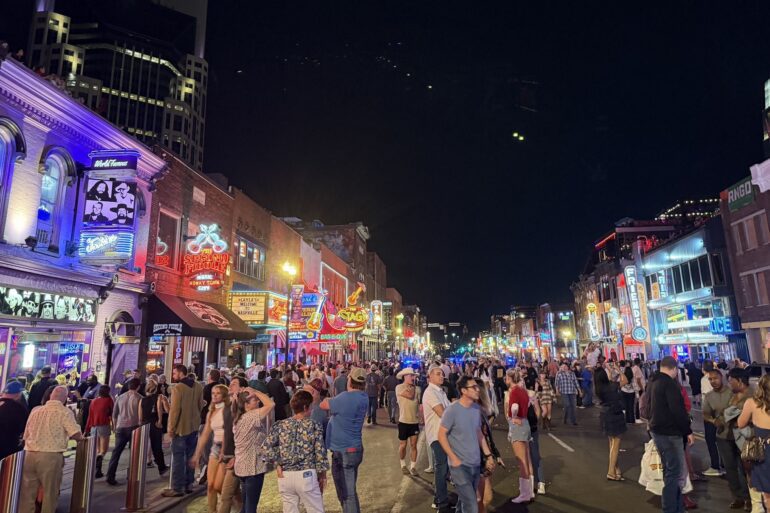
One of the most visible signs of the city’s growth has been Lower Broadway, the strip of bars in downtown Nashville that serves as a tourist destination and draws in millions of tourists every year to the dozens of bars located in a 5 block stretch.
Even when I moved to Nashville 10 years ago, Broadway was a fun place to go on weekends that was filled with small honky tonks and musicians playing mostly country music, with the occasional Journey or Paramore cover thrown in there.
But starting around 2017, things began to change. Those small honky tonks gave way to massive, multi-story entertainment venues owned by giant hospitality corporations and named after some of country music’s biggest stars. Six-story bars with bands on every floor became the norm, and as the bars grew so did the crowds.
Of course with that came a changing culture, from people who came to Nashville for gritty dive bars and live country music to a younger crowd looking to get drunk and party to top 40 hits, rock music, and DJs spinning EDM in the corner of fancy bottle service rooms.
And another consequence of all that growth is now turning into a full-blown crisis for many bar owners.
Property values in downtown Nashville have skyrocketed, with Jimmy Buffett’s Margaritaville recently setting the record for price per square foot when it sold to Raising Cane’s founder Todd Graves for a staggering $75 million.
Prices are being driven higher by out-of-state investors and hospitality companies eager to capitalize on Nashville’s growth. But with skyrocketing property values also comes the corresponding property tax increases – something that’s threatening to put many of the bars on Broadway out of business.
New property appraisals were completed in 2024, meaning that 2025 was the first year for the new tax bills that in some cases have quadrupled in just one year.
The issue first came to light last year when Rob Mortenson, the head of the Broadway Entertainment Association, told FOX17 that the rising taxes could very well spell the end for some of staples of the Broadway scene:
“These are folks that have been there for 40 years on Broadway, and, you know, they can’t pay the taxes. Their option is, I was told, we’re either going to go bankrupt or go to jail, one of the two, because we literally can’t pay the taxes.”
Layla Vartanian, the owner of Layla’s Honky Tonk on Broadway, also previously said that it’s the largest property tax increase she’s seen since she opened up her bar in 1997:
“I’ve never seen an increase of any kind of property tax or any kind of tax in such a short period of time. We’re having an increase of 300-400% on these buildings down here, on our commercial buildings. Even on personal properties, residential properties, the increase is 300% and 400%.”
And Tom Morales, owner of Acme Feed & Seed, recently made headlines when he warned that he may have to close his bar after his property taxes went from $129,000 to $600,000 per year overnight – which he says is more than his rent and net profit combined:
“Everything we work for this year is going to pay property taxes for next year, and we don’t even know where the economy is going. We’re scared shitless. We’re on the front lines of the economy.”
Nashville Mayor Freddie O’Connell, meanwhile, has been criticized for his seeming indifference to whether businesses are able to stay open.
In response to the warning from Morales, the mayor basically said it wasn’t his problem:
“It’s not up to me whether he keeps that business open. The market evolves. New businesses start even as beloved old businesses close.”
But now, the Tennessee legislature has passed a bill that will offer some relief to struggling businesses.
SB1672, which was passed last week by both the House and Senate, redirects a surplus of hundreds of millions of dollars to be used in part to help business owners on Broadway and in downtown Nashville who aren’t able to pay their property taxes.
The money being diverted comes from a fund that was created in 2009 to pay for the Music City Center convention center using sales tax collected in the downtown Tourism Development Zone. But over the years, the fund has accumulated a surplus of over $300 million.
Rather than give that money to Nashville’s General Fund, the bill passed by the legislature will direct that surplus to the East Bank Authority Board. The board is responsible for developing Nashville’s East Bank (the area across the river from downtown Nashville surrounding Nissan Stadium), with the funds expected to go towards infrastructure projects.
But also included in the bill is a provision that allows for surplus revenue to be used for “the payment of capital city economic assistance to eligible businesses and eligible commercial property owners within the tourism development zone.”
Translation: To bail out bars and other businesses in downtown Nashville.
There’s no doubt that the government using taxpayer money to bail out businesses will be controversial, on both sides of the aisle. Many will argue that the money should instead go towards public services, while others will argue that the fact that there’s a $300 million surplus just proves that taxes are too high in the first place.
It’s also a little ironic that taxpayer dollars are being used to help businesses being hurt by…taxes. Government efficiency, am I right?
At this point we don’t really know how much of the fund, if any, will be used for Broadway bars and businesses and how much will go towards East Bank development. The legislature has made clear that they don’t believe that Nashville mayor Freddie O’Connell should have access to that money, which is no surprise given the icy relationship between the two levels of government.
But there’s no doubt that the idea of bailouts for Broadway bars won’t help that relationship between the city and state.