


In the age old battle of “which animal would beat another animal in a fight,” give me bears all day, every day. What type of bear? Doesn’t matter, unless they’re fighting a bigger one.
Now I’m a big cougar fan (the wild cats guys… calm down), so for a brief second I was under the impression it may be able to compete with the smallest of the North American bears, the black bear, right? Wrong…
The American black bear and the mountain lion are two of North America’s most widespread and formidable apex predators. While they employ vastly different survival strategies, their shared habitats frequently force them into direct, high-stakes competition.
Let’s go to the tale of the tape:
Black Bears
Black bears are highly adaptable, opportunistic omnivores. While they are fully capable predators armed with powerful jaws and heavily muscled forelimbs, up to 85% of their diet consists of grasses, berries, nuts, and insects.
Because they spend the bulk of their year trying to pack on enough fat to survive winter hibernation, they are intensely food-driven and possess a sense of smell roughly seven times stronger than a bloodhound’s.
A mature male black bear typically weighs between 200 and 500 pounds, utilizing its sheer mass, thick hide, and brute strength to dominate food sources.
The Mountain Lion
Also known as cougars or pumas, depending on the region, mountain lions are hyper-carnivores that rely almost entirely on fresh meat, primarily hunting deer and elk. They are solitary, stealth-based ambush predators.
Lacking the stamina for long pursuits, they rely on explosive acceleration and a lethal bite to the back of the neck or throat to dispatch prey. After a successful kill, a mountain lion will gorge itself and then “cache” the remaining carcass by burying it under dirt, leaves, and brush to hide it from scavengers, returning over several days to feed.
An adult male mountain lion typically weighs between 120 and 170 pounds.
Where Paths Cross
These two predators share massive swaths of overlapping territory, particularly throughout the Rocky Mountains, the Pacific Northwest, western Canada, and even parts of the American Southwest. Florida also has both, but a rather small population of big cats. Both species thrive in rugged, forested terrains, heavily wooded canyons, and mountainous environments that offer thick cover.
Because they share the exact same geographical footprint and both rely on local deer populations (the lion for primary sustenance, the bear for opportunistic scavenging or spring fawn predation), their paths cross frequently.
When black bears and mountain lions interact, it is almost always driven by food theft… a biological behavior known as kleptoparasitism. A mountain lion will expend massive amounts of energy to stalk, kill, and cache a mule deer. However, the black bear’s unparalleled sense of smell easily detects the rotting cache from miles away. The bear will track the scent, uncover the carcass, and claim the kill for itself.
If the mountain lion is nearby or returns to feed while the bear is present, a tense standoff ensues. Despite the mountain lion being a much more efficient and lethal killer, the black bear almost always wins this confrontation.
In a direct physical clash, the bear’s massive size advantage, thick layer of fat, and dense fur simply offer more protection against a lion’s claws and teeth. And as a solitary predator, a mountain lion cannot afford to get injured; a broken paw or deep laceration means it can no longer hunt and will slowly starve.
Consequently, when a 300-pound black bear charges, a 140-pound mountain lion will usually hiss, bare its teeth, and ultimately surrender the hard-earned meal, retreating up a tree or into the brush to avoid a debilitating fight. It’s just not worth the potential injury from a paw swipe.
The rare exceptions where a mountain lion will actively fight, and occasionally kill, a black bear usually involve a mother lion violently defending her kittens from a predatory bear. Sometimes an exceptionally large male lion will ambush a small, juvenile bear or vulnerable cub. Otherwise, adult-to-adult conflicts usually end with the bear bullying the cat off its dinner.
And here’s the proof…
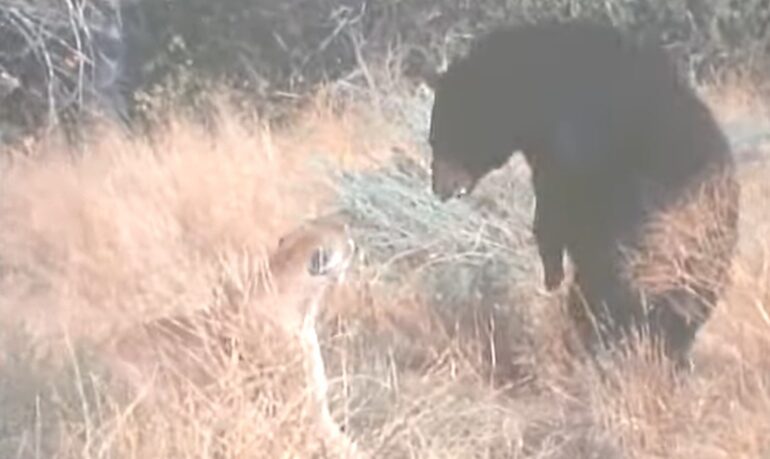
This vintage nature video shows a bear sniffing around what is actually a wolf kill site when a large cat decides he wants to poke around and doesn’t like the fact this bear is hogging the space. The cougar, also known as a mountain lion, approaches and starts screaming, swiping at the bear’s face with razor sharp claws and jumping around a bit.
But the bear is having none of it, even seems content to let the cat yell itself out and leave on its own terms.
However, there’s only so much of this he can take and eventually decides it’s time to bow up and run this cat out of town.
Now, there’s no denying this bear looks a little funny when he gets up on his back legs, but the cougar certainly didn’t think so, and after just a few back and forths, the bear chases it away and gets to revel in his glory, secure once again on top of the food chain. But maybe the craziest part of this who encounter is the fact they’re fighting over a piece of land that just smells like food… there wasn’t much left of the carcass anymore. The wolves cleaned out a deer the night before so all that’s left is the hope of a leg or organ left behind.
Proof yet again that nature is a cruel beast and that it’s so hard to survive, even the possibility of food will lead an animal to attack anything in its way.