

Many anglers dream about hooking into a massive muskie.
Muskellunge, or muskie(y) for short, are a North American freshwater sport fish that are flat-out fun to catch. They grow large, with the biggest of these toothy beasts weighing over 60 pounds and measuring up over 50 inches in length. Native primarily to the Great Lakes region, eastern Canada, the upper Midwest, and parts of the Appalachian river systems, they are biologically engineered for explosive ambush hunting. They have sleek, torpedo-like bodies made to strike with a quick burst of speed to surprise-attack their prey.
Dubbed the “fish of 1o,000 casts,” fishing for muskie can be slow and fruitless. Here in Wisconsin, I know multiple people who have made trips up north to fish for giants, and come home empty handed. I haven’t spent a ton of time on muskie lakes myself, nor have I specifically made a muskie trip, but they have eluded me so far.
On the other hand, I’ve netted a ton of their slightly smaller cousins, northern pike, and they can be a blast to catch as well. Although, when you’re targeting bass, as I often am, they can be quite a pain. They shoot out of the weeds and hammer your lure, sometimes cutting the line with their sharp teeth. Then you gotta re-tie, and maybe just lost your $15 Jackhammer Chatterbait… pain.
Back to muskie… the difficulty in catching them stems from their population biology: as top-tier predators, they exist in very low densities compared to other game fish. Furthermore, they are highly temperamental and easily conditioned to lures. They’re very curious, but will often follow a lure all the way to the boat without ever opening their mouths to strike.
Muskie Fishing
Fishing for them requires big lures and gear that they can’t tear through with their razor-sharp teeth. One you do hook into it, the fight presents an opportunity to test your skills even further.
Anglers will often use heavy-action rods up to 9 feet long, high-capacity baitcasting reels, 80-to-100-pound braided mainlines, and heavy wire or fluorocarbon leaders to prevent their teeth from slicing the line.
Musky lures are exceptionally large to trigger the predator’s instinct for a substantial meal. Popular choices include massive double-bladed bucktails, heavy rubber swimbaits, wooden glide baits, and large topwater prop-baits.
And of course, muskie fishing goes hand-in-hand with the signature “figure 8” pattern. Because muskies frequently track baits right up to the side of the boat, anglers are taught to never pull their lure directly out of the water at the end of a retrieve. Instead, they plunge their rod tip into the water and sweep the lure in a wide, fast “Figure 8” motion alongside the hull to trigger a last-second, highly aggressive reaction strike.
Modern musky fishing is built almost entirely on a strict catch-and-release, unless you’re that viral Amish guy. Because they grow very slowly, taking up to a decade to reach 40 inches, harvesting mature fish quickly decimates local populations. Anglers utilize massive, rubber-coated nets to keep the fish submerged while unhooking them, rely on specialized long-reach pliers to navigate their teeth, and strictly hold the fish horizontally to prevent fatal spinal damage before releasing them back into the water.
Handling big muskies definitely requires attention to detail, but if get the chance, get up north and give it a try… it’s unlike any other kind of freshwater fishing.
But if you’ve never seen these big predators in action, this video kind of sums up how ferocious these fish can be.
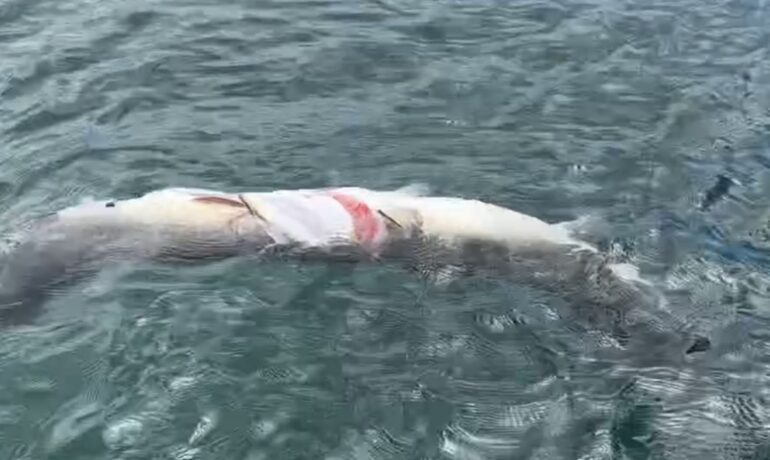
A group of smallmouth anglers stumbled upon a pair of muskies in one of the most unlikely scenarios. The boat spots a couple of big fish dead in the water (heartbreaking to see two beauties like that), with one 40+ inch muskie lodged in the mouth of one that appeared to be over 50. How’d that happened? I have no idea.
Some suspected that they were arranged that way by people trying to garner some viral internet clout, but I’ve definitely seen smaller fish, largemouth and smallmouth bass, locked up in the same predicament. Let’s be honest, stranger things have happened in the wild…
The video was shared by Great Lakes Finesse, a fantastic lure company making some great bass lures, with the caption:
“Two DEAD 45”+ Muskies! We estimate that one was for sure over 50”… Nature is nuts! Things you see on the Great Lakes chasing smallmouth bass.”
And just for fun, if you’re a smallmouth angler, or even a largemouth fisherman looking to up your finesse game, check out Great Lakes Finesse.
This little Juvy Tube is a straight up killer, and their underspin with finesse drop minnow combo is deadly for smallmouth as well. I’ve used them both… they flat-out work.
Shop the Juvy Craw Tube at Tackle Warehouse – $6.99
Shop the Drop Minnow at Tackle Warehouse – $6.99
* This post contains links from our Tackle Warehouse Affiliate Partners program. If you use these links to make a purchase, we may earn a commission at no additional cost to you.