

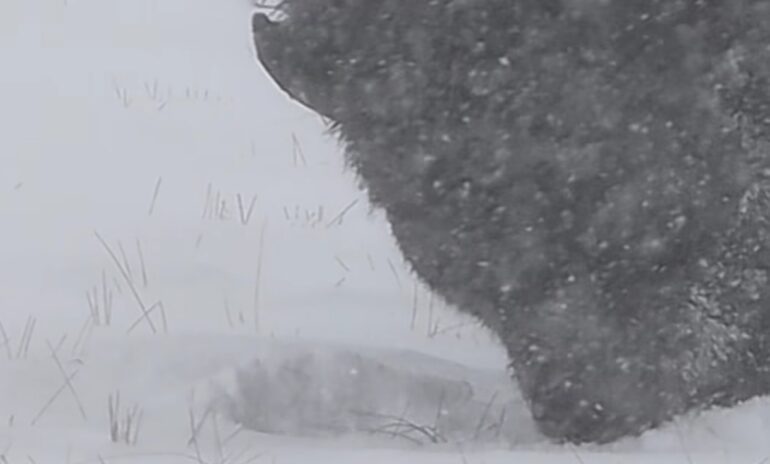
As the snow starts to fall in Yellowstone National Park, and some animals that call the area home flee for less-harsh winter conditions, bison will stay put and chow down in a way only they can.
Bison are just built different, and are officially (and scientifically) some of the toughest beasts on the planet. They better be if they are going to make it through some of the brutal winters that hit Yellowstone National Park every year. They’ve adapted to handle the worst of the winter, and most importantly, find food that no other grazing animals can get to.
Author and wildlife photographer Michael Hodges recently shared a video of a bison in Yellowstone eating the little amount of grass that was able to poke through the snow. The winter wonderland might look pretty, but it proves to be an ugly place to survive when temperatures drop and snow piles up.
Fortunately for bison, they don’t mind the tough conditions. A bison’s wooly coat helps them stay warm, allegedly creating such a thick layer of insulation that the snow landing on them doesn’t melt from the heat of their skin. It’s survival traits like those that are what help the massive 2,000 pound beasts make it through the harshest of cold conditions.
They’ve also evolved to only need a small amount of food during the winter months, usually through vegetation that’s far beneath the snow.
In the video below, you’ll see a small glimpse into how bison get their nutrients during the coldest period of the year. It’s all about knowing where to look, and being able to access the grass that’s buried underneath the winter’s snow. The incredible footage captured by Hodges showcases how bison are able to discover and consume grass and other vegetation that lays dormant beneath the wintry precipitation.
Bison first plow their way through feet of snow, and then use their head as a makeshift shovel (or snow scraper, whichever you prefer). Doing so clears away the heaviest of the snow, and reveals the plant life beneath that bison can utilize to maximize their nutrition intake. It also brings a whole other meaning to “using your head.”
When you see stuff like this, it should be no surprise that bison have managed to live and thrive in the American West for thousands of years. They’ve reportedly downsized a bit, but other than that, their species is going strong. Mostly thanks (or at least a little bit thanks) to their innate ability to turn their noggin into a snowplow when the situation calls for it.
Hodges detailed the food consumption tool that only bison have learned to master in more depth with his caption for the breathtaking video out of Yellowstone National Park:
“When severe blizzards slam into the Yellowstone ecosystem, burying the valleys under deep drifts, cattle will often stand in place and starve because they try to dig with their front hooves. Bison evolved a completely different physical strategy over thousands of years on the open Plains…
This behavior is made possible by distinct anatomical engineering shaped by harsh Northern Rockies winters. The distinctive hump on a bison’s back is actually a high ridge of spinal vertebrae packed with thick muscle and dense connective tissue that fastens directly to the base of the skull.
This powerful muscular leverage turns the head into an unstoppable shovel capable of pushing aside thousands of pounds of packed snow, allowing bison to thrive in winter environments where other large grazers simply cannot survive.”