

How exactly would that work?
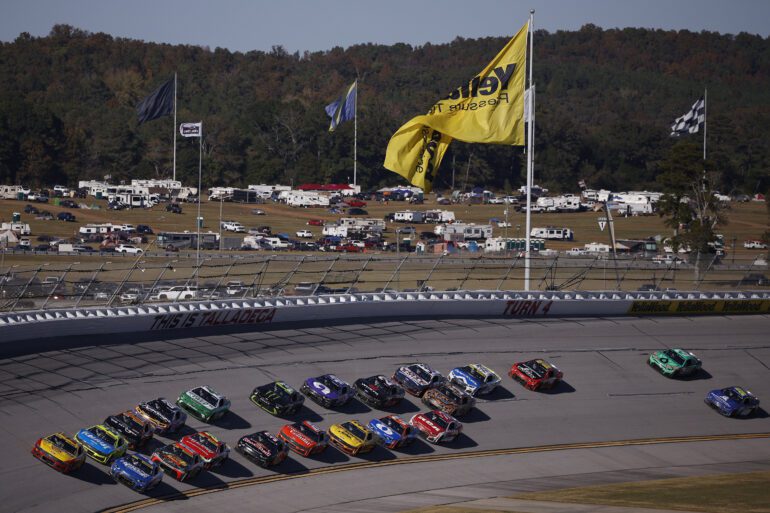
NASCAR has a superspeedway problem on its hands, and it’s never been more evident than this past weekend at Talladega.
The sport has been struggling over the past few years to figure out how to keep Cup Series drivers from running around at half throttle during the beginning of a run to save fuel at superspeedways, making changes to the stage lengths and spoilers this past season in order to try to improve the racing at Daytona and Talladega.
Well NASCAR was back at Talladega this past weekend, and it’s safe to say that changes they’ve made didn’t work.
For most of the first stage, cars were running around the track at as little as 25% throttle, sometimes going as slow as 155 mph on a day when the cars topped 200 mph for the first time in the era of the Next Gen car.
At one point the top three in the race were Gray Gaulding, Daniel Dye and Cody Ware, if that tells you anything about how slow they were going.
Drivers were even comparing it to the Richard Petty Driving Experience, where fans are able to ride around the track in a real race car at reduced speeds:
The only saving grace for the first half of the race came thanks to the RFK cars of Brad Keselowski, Chris Buescher and Ryan Preece. The teammates apparently decided to try something different, and while the rest of the field ran around trying to save fuel, the RFK cars floored it and nearly lapped the entire field – something that’s unheard of at Talladega.
It was no doubt embarrassing for NASCAR leadership, who couldn’t have been happy about seeing the cars playing follow the leader at half throttle for 50 laps in one of the most anticipated races of the season. And apparently, it was so bad that NASCAR eventually had to send a warning to teams to pick up the pace.
During this week’s episode of his “Hauler Talk” podcast, NASCAR vice president of racing communications Mike Forde said that at one point 75% of the field was running BELOW the minimum speed, which NASCAR sets each week to ensure that slow or damaged cars aren’t creating a danger on the track.
At Talladega, the minimum speed was within 12.5% of the speed of the pole winner during qualifying, so around 163 mph – well over what the cars were running during the first stage.
Generally when a car doesn’t meet minimum speed NASCAR gives them the black flag, forcing them to come to pit road to fix their car to try to get their speed up. And if they don’t pick it up, NASCAR will force them to park the car.
Of course that creates a problem when it’s the majority of the field under minimum speed – though Forde says NASCAR did warn teams to pick it up or risk getting black flagged:
“We can IM individual teams or the entirety of pit road. And so we IM’d all of pit road and said, ‘Hey, there are X amount of cars that have not reached minimum speed. If you guys don’t pick it up, then we’re going to have to step in.’ And soon after, they picked it up. So that message was delivered, and that’s why we did not black flag anybody.”
As Forde explained, NASCAR didn’t want to have to black flag the majority of the field, because sponsors pay big money to have their car out on the track. And it’s not clear what would have happened if they HAD issued the black flag to 75% of the field: Teams generally have one or two laps to try to meet minimum speed, so there may not have actually been any penalty because the cars could have just picked up the pace immediately to avoid having to park.
But it’s clear that leadership wasn’t happy with what happened during the race, which hopefully means that NASCAR will make changes before the Daytona 500 to keep the problem from happening again.