

This is nightmare fuel… I mean, I like the movie, but I don’t want to live in any Jaws-like scenario.
As a kayak fisherman myself, it can be a little bit different than fishing from a boat. Granted, it doesn’t need gas, you can take it just about anywhere, and get into places that are tough to fish, but you’re much more at the mercy of the environment around you. Big waves, whether from Mother Nature or just some dude with a wake boat, can have you bobbing around like a madman out there, but you’re also more exposed to the wildlife. For me in Wisconsin, that’s not a big deal… but if you’re bass fishing down in Florida, you have to be mindful of gators.
If you’re fishing out in the ocean, the stakes are even higher. Bigger waves, bigger fish, bigger everything… this is why the ocean is such a crazy place. You never know what you are going to catch, see, or run into out there. It’s just a whole bunch of water and a whole bunch of mystery. Every time I see someone going out into the beast bearing only a kayak and a fishing rod, I have to tip my cap in respect.
Whether they’re catching a giant halibut off the coast of Alaska, or getting dragged 15-miles by a marlin, or maybe a guy beating an angry hammerhead with nothing but a paddle, it is always an adventure. If you’re going to go out be extreme like this make sure you know the risks and have safety nets in place because it can get wild.
The one thing you don’t want to encounter kayak fishing on the ocean is… sharks. Specifically… a great white.
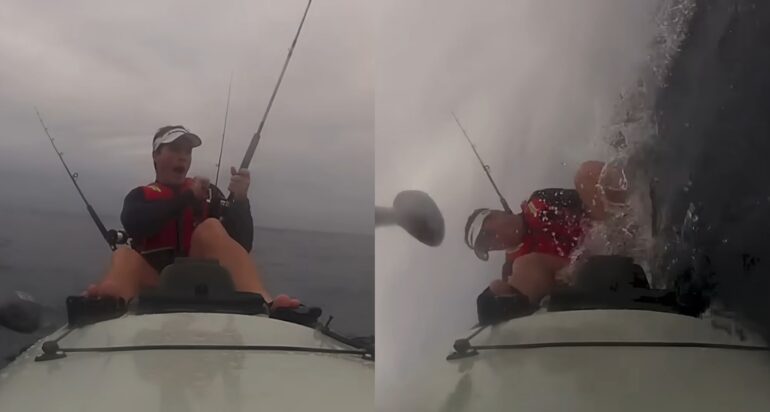
This kayak fisherman set out for a fun day on the water. With cameras set on his kayak, the fisherman starts casting away and hooks into a fish. During the excitement of reeling in the fish, the man realizes a big old shark is chasing the fish and they’re both headed straight for the boat. The fisherman starts to lose it just as you can see the shark. The shark runs right into the back of his kayak and flips everything over. The fisherman frantically flips over his boat and jumps in as quick as he can. Luckily, he got back in the kayak before the shark could take a run at him.
Talk about getting the heart pumping… thankfully he was unharmed, but he left with one hell of a video:
Do Great Whites Attacks Human?
It’s no secret that the great white shark is one of the ocean’s most formidable apex predators. Found in coastal and offshore waters across the globe, these massive fish can grow over 20 feet long and weigh more than 4,000 pounds. They are perfectly adapted hunters, possessing a torpedo-shaped body for explosive speed, rows of serrated teeth for shearing flesh, and a highly advanced sensory system that allows them to detect a single drop of blood in 100 liters of water. Their primary diet consists of marine mammals like seals, sea lions, and small whales, which they typically hunt using an ambush strategy, striking from below with tremendous force.
Despite their terrifying reputation in pop culture, great white sharks are not the mindless human-hunters portrayed in movies. When it comes to their aggressiveness toward humans, the reality is much more nuanced. Humans don’t actually make a good meal for sharks. We are too bony and lack the high-fat blubber needed to sustain their massive bodies. When a great white does bite a human, marine biologists widely believe it is usually a case of “mistaken identity” or an exploratory bite. Like some other animals, they investigate unfamiliar objects in their environment by mouthing them. Bass do the same, which might be why weird-looking urchin baits are so popular right now… they’ve never seen anything like it. But due to the size and power of a shark’s jaws, a single exploratory bite is often devastating, sometimes fatal, for a human, even if the shark immediately lets go.
Their interactions with boaters and kayaks are usually just driven by curiosity. Great whites possess a network of jelly-filled pores on their snouts called the ampullae of Lorenzini, which allow them to detect the electromagnetic fields generated by living animals. Outboard motors, boat electronics, and even the metallic components of a kayak can create electrical currents in the water that mimic the distress signals of wounded prey.
Because of this electromagnetic stimulation, great whites will frequently approach, bump, or even bite the propellers and hulls of boats. A shark “ramming” a kayak is often not an act of malicious aggression, but rather a sensory investigation or a predatory strike intended for what the shark’s highly tuned senses mistakenly identified as a seal. Surfers, with their hands and feet hanging over the edge of the board, are often mistaken for seals.
In this case, it seems like the shark was actively following the fish on the kayaker’s line… it probably never expected to run into the hull of the kayak. All that to say, great white sharks are not patrolling the oceans looking for kayakers to eat… but, you certainly need to have your head on a swivel in shark waters.