


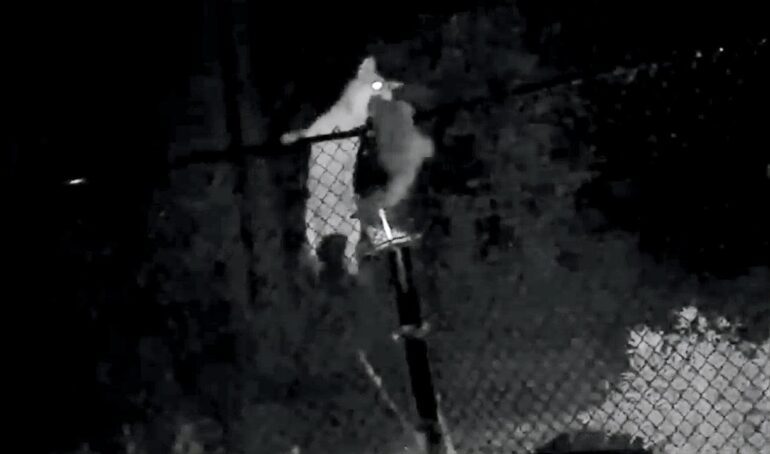
Score one for the lonesome coyote.
As a nature lover like myself, you probably wonder how many insane feats of athleticism have been done by animals in the wild that we’ll never see. Mountain lions jumping out of trees onto the back of an unexpecting deer. Alligators leaping like dolphins out of the water to grab a low flying bird. A bear scaling a tree so fast it would blow your mind.
Granted, we occasionally see incredible video footage… shoutout to all the nature photographers out there and the occasional Ring doorbell camera. I actually put a trail camera in my backyard for a little bit last summer. My kids were super excited to check the footage every morning, and you’ve be surprised what kind of critters visit your yard when the sun goes down… raccoons, possums, foxes, the occasional deer.
But just think about everything that happens in the wild when nobody is around to see it.
While this video doesn’t show anything quite as spectacular as those, it does give a good example of what wild animals are capable of when food seems just out of reach. A trail cam caught the end of a tussle between a coyote and a raccoon, with the raccoon thinking he had outsmarted the coyote by climbing to the top of a fence, which looks to be of pretty decent height. Smart thinking, right? I mean, when you take a raccoon up against a coyote, climbing seems like one of its only advantages.
But alas, the coyote decides to show up the hops and after a few attempts, is able to grab the raccoon off the fence and it’s goodnight for our striped friend. Like an NBA player testing their vertical, the coyote leaps as high as it can, and with a quick flick of the snout, snatches our poor trash panda right off the pole.
There is also a second video posted by the same guy where a raccoon is able to fend off the coyote in the exact same spot, but this does raise the question. The raccoons are on top of a fence. A fence is designed to keep things out… why not just drop over to the other side and laugh when the coyote is a foot away but unable to get you? Well, because the coyote can probably jump it, that’s why.
Ask anyone who has tried to keep chickens alive in their yard… in order to keep a coyote out, fences are recommended to be a whopping 8 feet tall and at least 18 inches into the ground. So even though a coyote can only jump about 3-4 feet, they can climb and they can dig. Sitting on top seemed like it might’ve been the safest spot for the raccoon… and he still lost.
Raccoon wins:
Coyotes vs Raccoon
Coyotes and raccoons are two of the most successful and widespread mammalian predators in the United States. Despite belonging to entirely different biological families, they share a remarkable resilience that has allowed them to not just survive human expansion, but actively thrive alongside it. Both species are supreme opportunists and highly adaptable omnivores.
Whether roaming the dense forests of the Pacific Northwest, the arid deserts of the Southwest, or the sprawling concrete suburbs of the East Coast, both animals have figured out how to turn human development to their advantage. They are primarily nocturnal or crepuscular, using the cover of darkness to navigate neighborhoods, scavenge for food, and avoid direct human confrontation.
Physicality and Navigation
Where these two animals dramatically diverge is in their physical adaptations and how they interact with their environments. The coyote is a canid, built for endurance and speed. With long legs, a slender frame, and sharp senses of smell and hearing, the coyote is a cursorial hunter designed to run down prey over open ground. They are strictly terrestrial, covering massive territories to find food.
The raccoon, on the other hand, is built for climbing and complex manipulation. With a stocky build, a ringed tail for balance, and distinct, un-webbed front paws that function almost like human hands, raccoons experience the world through touch. While a coyote will jump a fence or dig under it, a raccoon will easily scale a tree, unlatch a gate, or pry open a reinforced trash can lid.
Diet and Social Dynamics
Their approaches to hunting and social structure also highlight their differences. While both eat practically anything, coyotes lean heavily toward the predatory side of omnivory. They actively hunt small mammals like rabbits and mice, and can even take down larger prey like deer fawns or livestock, sometimes working in family units or pairs to do so. Coyotes are highly communicative, using a complex system of howls and yips to maintain territorial boundaries and pack cohesion.
Raccoons are much more solitary and heavily favor scavenging or foraging over active predation. A raccoon is just as likely to eat wild berries, frogs, and insects as it is to gorge on stolen pet food or leftover pizza. They do not hunt in packs, nor do they claim massive territories, preferring instead to quietly exploit the resources concentrated in a much smaller home range.
Habitat and Shelter
When it comes to finding shelter in the United States, their strategies once again contrast. Coyotes generally bed down in heavy brush or tall grass during the day, only excavating deep underground dens during the spring to raise their pups. They require a certain degree of open space and natural cover to feel secure. Raccoons, however, are cavity dwellers that actively seek out enclosed, elevated, or fortified spaces year-round. Before human development, they relied on hollowed-out tree trunks or abandoned burrows.
Today, they have seamlessly transitioned to utilizing the architecture of the United States, frequently making their homes inside residential attics, chimneys, and municipal storm drains.