

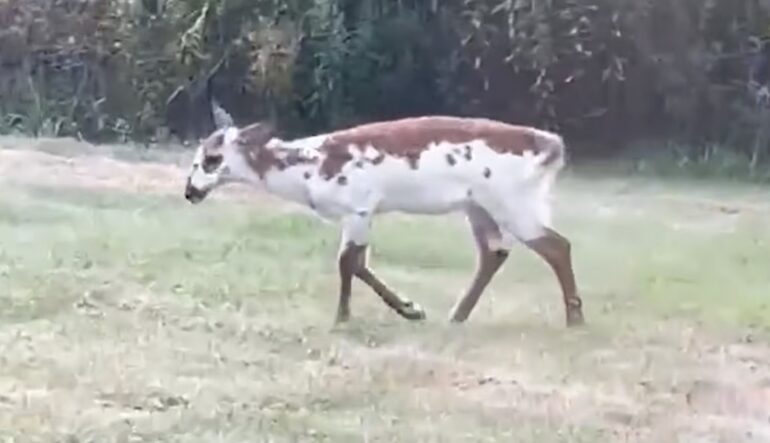
An incredibly rare piebald deer was recently spotted – and captured on camera – up in Cumberland, Maine this week.
It would be an understatement to say that Mother Nature provides plenty of surprises. We can all get a little numb to the wonders of nature, but if you stop to look around every one in a while, there’s endless beauty in every living thing. One Maine resident happened to be looking in the right place at the right time just yesterday, and saw what one of nature’s wonderful rarities: a piebald deer.
In case you aren’t familiar, piebald is a genetic condition that causes some portions of the skin, fur or hair to lack pigmentation. Most of the time, that results in black and white spots, or in some cases brown and white spots, popping up on the animal. Regardless, it creates a unique color pattern that makes the creature stand out from the rest.
Obviously, a deer that’s mostly white, or just partly white, is going to stick out like a sore thumb in the grassy habitats that they usually call home, which makes them more prone to being attacked. In addition, being piebald is often accompanied with genetic issues, like skeletal deformities that can significantly shorten an animal’s lifespan. All that to say, there might be a large number of piebald animals born out in the wild… but a lot of them don’t survive long enough for anyone to see them.
Fortunately, this youngin’ looks to be doing well, and we all get to see the incredible creature thanks to Alison Cushing – who took the video of the deer as it walked through her backyard. The young deer with spots still visible on the more brown parts of its back was traveling with another fawn (non-piebald) and its mother when the Maine resident got her phone out to get the unique animal on camera.
Piebaldism only affects about 1% to 2% of the white-tailed deer population, which makes seeing one incredibly rare. One in every 1,000 deer have piebald traits, and it’s that uncommon because it’s a recessive genetic mutation, meaning that both parents must carry the piebald gene to pass it down to their offspring. And as we saw in this video, it doesn’t affect every fawn.
The little one in the video below is a beauty… but like I mentioned earlier, that type of coloring doesn’t help with predator avoidance. Despite that, here’s to hoping the little fawn grows up to be a big ol’ piebald whitetail. A recent video that went viral did show that it’s possible for albino and piebald deer to live long and prosper (accidental Spock reference there, sorry), so hopefully this one does the same as it grows older and eventually leaves its mother’s side.
Check it out:
What a beautiful creature.
Seeing a piebald animal is something that wild photographers often dream of. And not only are they extraordinary and unusual… some cultures believe that piebald, leucistic, and albino animals are actually magical. At the very least, piebald animals were often viewed to be spirits or signs of good luck.
I’d certainly be feeling lucky if I ever got to see one in person.