

Gonna need a bigger boat…
I’m not gonna lie, if you saw this video with no context, you would’ve thought it was a deleted scene from Jaws. Of course, any who has spent any time in “outdoors” corner of the internet has seen several videos of sharks over the years… people nearly getting their faces bitten off by the creatures while diving, sharks ramming into the side of boats, and people accidentally catching them while fishing for a completely different species. Shark Week is a thing for a reason… sharks are pretty rad creatures.
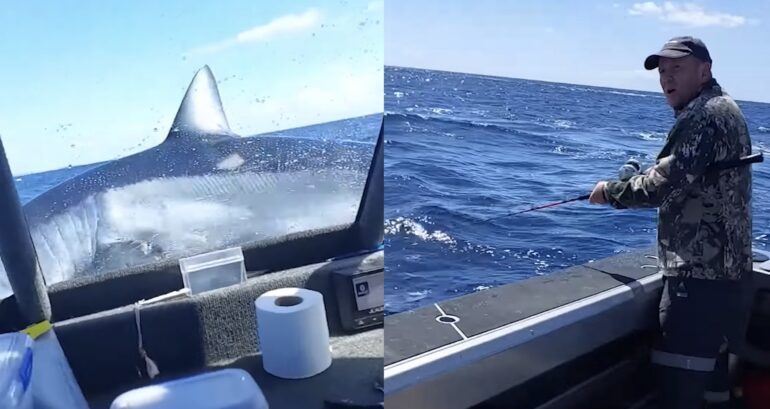
But I have to say… I have NEVER seen a video of a shark leaping from the water, and landing directly on top of a boat… and that’s exactly what happened here.
This one all went down during a fishing charter off the coast of Whitianga, New Zealand. Ryan Churches, the owner of Churchy’s Charters NZ was the lucky one to catch it all on video. As you can see in the wild footage, a MASSIVE Mako shark leaps from the water, and lands directly on top of the front end of the boat. It doesn’t appear that this particular shark was hooked up on (Churchy’s primarily guides for kingfish, hapuku, bluenose and snapper), but when you’re around makos, anything can happen.
Needless to say, it’s a miracle that nobody was standing on that side of the vessel, and nobody, nor the shark, was harmed.
The caption to the video reads:
“Crazy moment when this Mako Shark jumped onto the front of the boat! Definitely had my heart racing!”
Ironically you can hear Wings’ “Band on the Run” in the background, with the line “if I ever get out of here” in the second verse. Have to imagine that’s what the shark was thinking too.
More On Mako Sharks
The mako shark, specifically the shortfin mako, is widely celebrated as the cheetah of the ocean.
Built for insane water speeds, they are the fastest species of shark in the world, capable of reaching blistering top speeds of over 40 miles per hour in short bursts. It also makes them one of the fastest fish in the entire ocean, second only to some species of billfish (marlin, swordfish, etc…). Their bodies are basically shaped like torpedoes, with a conical snout, large black eyes, and a powerful crescent-shaped tail that provides explosive propulsion.
While there are two distinct species of makos, the shortfin and the elusive, deeper-dwelling longfin, it is the shortfin mako that typically dominates the spotlight and the open ocean.
Range
You can find them in virtually all temperate and tropical waters across the Atlantic, Pacific, and Indian Oceans. Rather than being tied to a specific geographic region, their movements are heavily dictated by water temperature and the migration patterns of their prey. They typically prefer cruising in waters ranging from 62°F to 71°F, meaning they will actively migrate poleward during the warm summer months and head back toward the equator as the ocean cools in the winter.
In the United States, this temperature-driven migration means they are a familiar sight for offshore anglers on both coastlines. On the Atlantic side, shortfin makos range from the warm currents of the Gulf of Mexico and Florida all the way up to the cooler, nutrient-rich depths off the coast of New England and Nova Scotia during the late summer. On the Pacific coast, their territory stretches from the deep waters of Southern California up through Washington state, where they often patrol the same offshore banks as the tuna and yellowtail they love to hunt.
Acrobatics
Like their close relative, the great white, mako sharks possess a unique heat-exchange circulatory system that allows them to maintain a body temperature significantly warmer than the surrounding water. This endothermic advantage fuels their massive muscles, granting them the immense stamina required to chase down some of the fastest and most agile prey in the sea, including yellowfin tuna and even full-grown swordfish.
As we saw in the video above, makos are famous for their spectacular aerial acrobatics when they are hunting or trying to shake off a fishing hook. They’re capable of launching their massive bodies 20 to 30 feet out of the water.
Conservation
Unfortunately, the very traits that make the mako shark so incredible have also put its survival at serious risk. Their speed and dramatic, high-flying fights have historically made them one of the most highly prized targets in the offshore sport fishing world, while their meat has been heavily exploited by commercial fisheries. Combined with the devastating impact of being caught as unintentional bycatch in commercial longline operations, shortfin mako populations have plummeted in recent decades.
Today, they are globally classified as endangered, prompting strict international regulations, catch-and-release mandates, and retention bans designed to help this magnificent apex predator recover before it is too late.