


If you’ve ever thought about making a trip to hunt out West, consider this your sign.
Hunting out West in states like Colorado and Montana is a whole different animal (quite literally, in many cases) than in the eastern portion of the country. While the West is defined by unending stretches of rugged public land and physically demanding spot-and-stalk tactics, the Midwest and South generally rely heavily on private land access, agricultural patterning, and strategic ambush hunting.
When it comes to terrain and access, the West is dominated by massive expanses of accessible public land, including millions of acres of National Forest and Bureau of Land Management (BLM) ground. Hunters navigate high-altitude alpine basins, steep timbered ridges, and wide-open sagebrush flats. Conversely, hunting in the Midwest and South consists of dense hardwood forests, agricultural fields like corn and soybeans, pine thickets, and swamp bottoms.
Because of these distinct environments, the target species also differ drastically. Western hunters primarily pursue Rocky Mountain elk, mule deer, pronghorn antelope, black bears, and mountain lions. In the Midwest and South, whitetail deer are the undisputed kings of the woods, with hunters also heavily targeting wild turkeys, waterfowl, and feral hogs, particularly in Texas and the southern states.
The physical and logistical demands of each region are uniquely challenging. Western hunting is notoriously grueling, frequently requiring hunters to backpack miles into the wilderness, navigate thin air at elevations above 10,000 feet, and take long-range shots. If a hunter successfully drops an elk, they must quarter the heavy animal in the field and pack it out on their back over multiple trips. While Midwestern and Southern hunting requires less cardiovascular endurance, it demands immense mental stamina and a tolerance for extreme elements, as hunters often sit perfectly still in freezing temperatures for hours at a time.
But one of the biggest differences is the opportunity to come across predators… it’s far more common out West, and the stakes are much higher.
Elusive Predators
Seeing an apex predator in the wild is an amazing, rare, exhilarating experience. It can be frightening in the wrong situation, but downright fascinating at a safe distance. Of course, when you’re hunting in a location where grizzly bears, mountain lions, and wolves are present, it just adds an extra element to the hunt… one you have to plan for. Some hunters even opt for predator tags in the event they come across a mountain lion or a wolf in areas where they can legally be hunted.
Mountain lions are one of the most elusive predators in North America, and as the old saying goes… if you see one, chances are, it saw you first. However, that’s not always the case, as we’ll see here in a minute. Also known as cougars or pumas, they are solitary, highly adaptable apex predators built exclusively for stealth and explosive power rather than prolonged pursuits.
They possess incredibly powerful hindquarters that allow them to leap up to 18 feet vertically into a tree or cover 40 feet horizontally in a single bound. Their tawny coats provide perfect camouflage in rocky, brushy, or forested terrains.
Unlike wolves or coyotes that run their prey to exhaustion, mountain lions are classic ambush hunters. As we’ll see in the video, they silently stalk their target, often using elevated terrain, rocky outcroppings, or dense cover to get within 30 feet before launching a short, lightning-fast sprint to pounce.
Taking down an elk, which can weigh between 500 and 700 pounds for a cow, with bulls exceeding 1,000 pounds, requires absolute precision—and it’s super common, to be honest. Because a mature mountain lion typically weighs only 100 to 180 pounds, it cannot overpower an elk through brute force and risks fatal injury from getting kicked or trampled. Instead, the lion relies on the momentum of its ambush to knock the massive ungulate off balance. It secures its grip with heavily muscled forelimbs and retractable claws, delivering a highly targeted, lethal bite to the back of the neck to sever the spinal cord, or directly to the throat to crush the windpipe.
Because a single elk provides far more meat than a mountain lion can consume in one sitting, the cat will use its immense strength to drag the heavy carcass to a secluded, shaded area. It will then “cache” the kill by raking leaves, dirt, pine needles, and debris over it to hide the scent and sight from scavengers like bears, eagles, and coyotes, returning to feed on the carcass for over a week.
Mountain Lions in Action
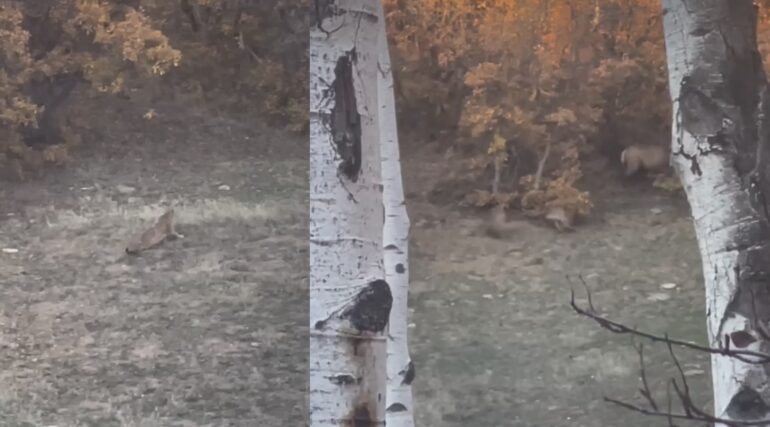
This video here shows you exactly how they like to set up for a hunt. Our hunter is up in a tree in Colorado, waiting on some elk to come in through a line of trees. But another hunter is already onto this herd… a mountain lion.
The mountain lion quietly creeps across the clearing and gets down behind some brush, patiently waiting for the elk to walk right into its kitchen. It crouches down low so as not to alert the elk to its presence. Then along comes the cow elk… and just as she gets close enough to the clearing, the cougar pounces from behind the brush, just a few feet away from the cow elk when it made its move.
The chase is on… you don’t see what happens as they both run into the tree line, but that cat may have come out with a meal.
Oh, and a couple days later… our hunter got his elk: