

It’s all fun and games until the monsters from the deep come for you…
In the sportfishing world, there aren’t many more exhilarating moments than hooking into a big marlin.
Don’t get me wrong, I LOVE a topwater bass bite, but ocean fishing is just a different beast. Big water, big boat, bigger tackle, bigger stakes… the next time you’re out in Florida, I highly recommend getting a guide to take you out. It doesn’t even have to be something as grandiose as marlin… even shallow water snook fishing is really fun.
But marlin fishing in the United States offers some of the most incredible offshore big-game action in the world. With multiple species found on on each side of the country, it is a highly specialized, gear-intensive pursuit that requires heavy offshore vessels and crews willing to hunt deep blue water.
It’s not for the faint of heart… and here’s the proof.
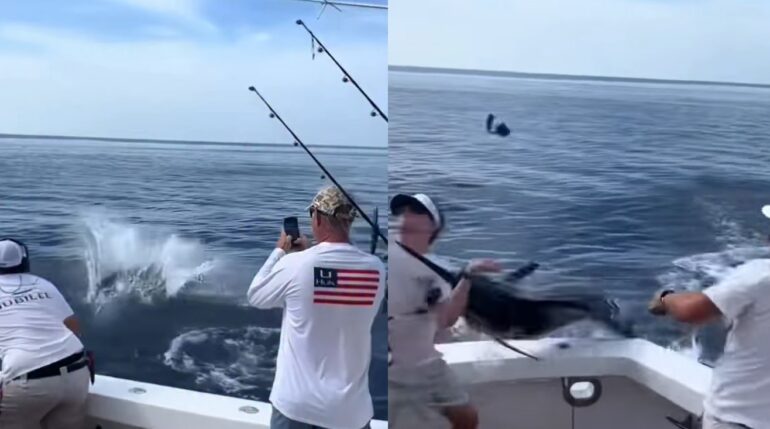
One group of deep sea fishermen in the Gulf of Mexico, off the coast of Alabama, caught an insane moment on camera while reeling in a blue marlin.
The video picks up after they’ve already hooked the blue marlin and have it pretty close to the boat. The crew is working the line to get it in as many of the other men on the boat pull out their phones to record the beautiful moment in nature. As the fish nears the boat, a leap into the air goes wrong.
The fish launches out of the water and propels itself right into the boat. Its pointed bill hits one man sitting in the chair with the rod, forcefully pushing him to the ground. Thankfully, the fish’s bill did not impale the man, as you can see it come flying right under his chin, knocking his headphones off. The fish quickly flopped out of the boat, but not before the man saw his life flash before his eyes.
Talk about a CLOSE call:
@fairhope_fishing_company Close call on the Jubilee today. Thankfully everyone was ok. #bluemarlin #offshorefishing #bluewater #jubilee #gulfofmexico #bluemarlinfishing #deltahouse ♬ original sound – fairhope_fishing_company
Billfish, such as swordfish, marlin and sailfish, can be quite dangerous to land as they will often fight hard and fast, bursting out of the water to try and shake the hook. When they get close to boat, they can land inside, flailing about with their pointed bills.
While pretty rare, impaling injuries can happen. A man was tragically killed by a swordfish in 2015 off the coast of Hawaii when it stabbed him in the chest.
Viewers quickly filled up the comments, noting that while they were happy the man was not seriously injured, they couldn’t help but poke some fun at the theatrical screams from the man.
“Almost got Steve Irwin’d by a dang Marlin.”
“I think he thought he was dead…”
“My guy saw the light and panicked.”
“The Marlin said, ‘I’m taking one of you out with me.’”
“Glad he stayed calm.”
“Not only did he see his life flash before his eyes, he hit the floor and assumed the position.”
“This needs to be on family guy.”
But I can’t blame him… this man probably saw the light and was thinking those were his last moments. Dude might take a break before his next deep sea fishing trip after this…
Marlin Fishing In The United States
Here’s a brief rundown on American marlin fishing, including types, locations, and the kind of gear it takes to haul in these deep-sea beauties:
Blue Marlin: The apex predator of offshore fishing. Pacific blues (found in Hawaii) and Atlantic blues (found in the Gulf and East Coast) can exceed 1,000 pounds (a “grander”). They require heavy tackle and are known for blistering runs and violent surface breaches.
White Marlin: Primarily found in the Atlantic. They are the smallest of the marlin species (typically 50 to 90 pounds) but are highly prized for their acrobatic jumps, aggressive pack-feeding behavior, and the highly technical light-tackle skills required to hook them.
Striped Marlin: Found in the Pacific. Averaging 100 to 200 pounds, they are known for their prominent neon-blue stripes that “light up” when they are aggressively hunting baitballs.
Premiere US Marlin Destinations
Kona, Hawaii (Pacific Blue Marlin): Kona is one of the few places on earth where you can catch a grander blue marlin just a few miles off the beach. The island’s volcanic structure creates steep oceanic drop-offs and calm leeward waters, making it a year-round fishery, though summer is the peak.
Ocean City, MD & The Outer Banks, NC (White & Blue Marlin): The Mid-Atlantic coast is world-renowned for marlin. Ocean City literally holds the trademark as the “White Marlin Capital of the World” and hosts the White Marlin Open every August, the richest billfish tournament on the globe with payouts exceeding $14 million.
The Gulf of Mexico (Blue Marlin): Ports like Destin, Florida, Venice, Louisiana, and the Texas coast serve as launching pads into the deep Gulf. Anglers here target massive floating oil rigs—which act as artificial reefs in thousands of feet of water—to find blue marlin feeding on tuna and bonito.
Southern California (Striped Marlin): During the late summer and early fall, warm water pushes up the coast from Baja, bringing striped marlin into range for boats launching out of San Diego and running to areas like the Catalina Channel.
Core Tactics and Gear
Trolling: The most common method involves dragging a spread of artificial skirted lures or rigged dead baits are fairly slow cruising speeds. This allows boats to cover vast amounts of open ocean while searching for temperature breaks, color changes, or floating debris.
Bait and Switch: A highly active technique where hookless lures (teasers) are trolled close to the boat. When a marlin surfaces and aggressively attacks the teaser, the crew quickly reels the teaser away while a waiting angler pitches a hooked bait directly into the enraged fish’s path.
Live Baiting: In the Gulf and California, slow-trolling live baits like small tuna, mackerel, or bonito is highly effective when holding over a specific piece of structure or a concentrated baitball.
Because marlin mature slowly and face heavy pressure from international commercial bycatch, the US recreational fishery is heavily geared toward conservation. The vast majority of marlin caught by US anglers are safely released.
Federal regulations also mandate the use of non-offset circle hooks when fishing with natural bait in tournament settings, significantly reducing fatal deep-hooking and ensuring these apex predators survive to fight another day.