

Bobcats, with their striking appearance and elusive nature, command attention as enigmatic creatures in North American ecosystems. These medium-sized wildcats, identified by their distinctive tufted ears and short, bobbed tails, navigate a variety of habitats, from dense forests to arid deserts.
Renowned for their nocturnal habits and solitary lifestyles, bobcats are skilled hunters, preying on small mammals and birds and even snakes with remarkable precision.
In the realm of wildlife conservation, understanding the behavior and habits of bobcats becomes crucial because presence not only signifies the health of the environment but also highlights the delicate interdependence of species. With their primary predators being mountain lions, and perhaps wolves or coyotes, they generally have few encounters with other predators past the kitten stage of life.
But for this kitty, a venomous rattlesnake was quite the ferocious opponent. And remember, bobcats do not possess any biological immunity or resistance to rattlesnake venom. Unlike opossums, California ground squirrels, king snakes, and even pigs in many cases, a successful strike from a mature rattlesnake can cause severe tissue damage, necrosis, or death for a bobcat.
Bobcats rely entirely on their elite agility and reaction time. As fast as snakes can be, a bobcat’s reflexes are significantly faster than a rattlesnake’s strike, allowing the cat to dodge the fangs by mere fractions of an inch.
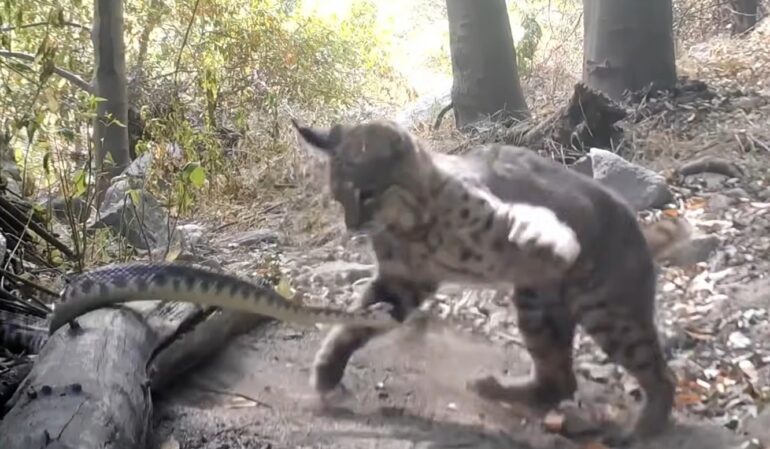
When a bobcat engages a rattlesnake, it typically circles the snake to force it into a defensive coil. The cat then uses lightning-fast, calculated paw swipes to continuously bat at the snake’s head. The goal is to exhaust, disorient, or stun the snake. Once the snake is sufficiently fatigued or its head is pinned, the bobcat moves in for a precision kill bite. It clamps its jaws directly onto the back of the snake’s head or neck, crushing the skull or severing the spinal cord to neutralize the threat of a bite before consuming it.
It’s quite wild to watch it play out in real-time, and thanks to this trail cam footage, we have a front row seat to this high-level boxing match.
A bobcat and a rattlesnake squared up in Angeles National Forest in Arcadia, California in just the right spot to be captured on a trail cam, and it’s one of the best displays of the insane reaction time of cats, especially wild ones.
Both sides were quick. One side had the size advantage but it was matched by the other’s one-strike power. A match up for the ages, but one must prevail, and this time size was victorious. Rattlesnakes strike at about 10 feet per second, which doesn’t seem very fast, but when you realize they can hit your hand from a foot away in a tenth of a second, you start to realize it’s scary fast…
But even more impressively, the bobcat is able to dodge every single attack thrown out by the snake and secure a win with a combination of strikes and one well placed bite. Safe to say it wasn’t the first time he’d taken out a rattlesnake, and judging by the success, it won’t be the last.