

While I hate to divulge what might be a best-kept secret, living in Wisconsin is incredible. I just saw a recent study that called it the #3 state to live in right now, and it’s not hard to see why. It’s relatively affordable, people are nice, crime is low (well, outside of Milwaukee), schools are good, healthcare is good, and you have a ton of access to the great outdoors (and beer… lots of beer here, too).
There are lakes everywhere, and no matter what you’re into… fishing, hunting, hiking, etc… you can find somewhere close to do it. And even throughout the winter, people love to get outside… ice fishing, hockey, snowmobiling, cross-country skiing, you can do it all.
I spent 16 years living in multiple neighborhoods across Chicago, and while I’m grateful for that time in my life, I just love raising my kids here (still a Bears fan though). They’re always outside playing, exploring, and coming face-to-face with nature at a level that just isn’t possible in most major cities. And sometimes, they get a front-row seat to nature in a way that is just jaw-dropping.
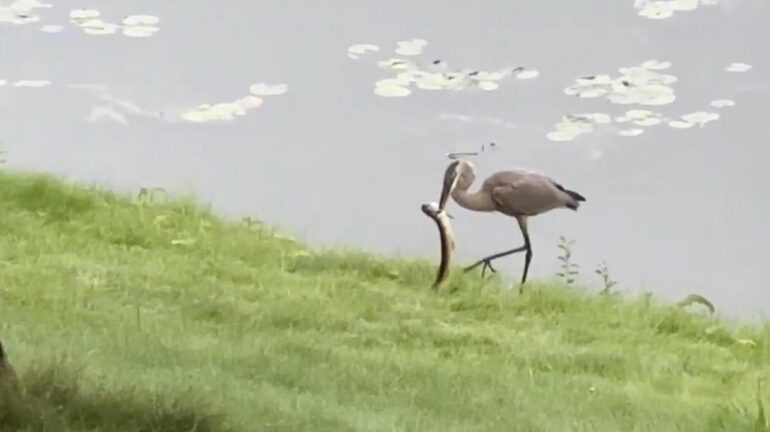
A couple of days ago, we woke up to find a great blue heron sitting on a kayak on our dock. It’s not uncommon to see a heron along the shore or even on the dock, but up on top of the kayak is something I have never seen before. But in seconds, it was clear why… he was scoping out a northern pike in the shallow water, one that was probably about the size of my forearm. Definitely not big by northern pike standards, but when you look at a heron’s neck, this pike becomes VERY large.
Hopping off the kayak in a flash, he speared the pike and brought it onto the shore, holding onto it securely while it flopped around (where the video begins). It stabbed the fish repeatedly with its beak to ensure that it was dead (it actually flopped back into the water at one point, and within seconds, the heron speared it again and brought it back to the shore). Finally, the heron flipped it head-first and wolfed it down in a couple of gulps… a fish that was probably bigger than its own neck. How it forced it down whole, I have no idea. It was just an insane, front-row seat to nature in action.
The whole scene played out in about 5 minutes, but I pieced together a few different video clips to capture the action. Enjoy commentary from my wife, who was absolutely stunned, and my 4-year-old daughter, who was more excited about going on a wagon walk than the carnal feast going on out on the lakeshore. Oh, and please excuse my terribly unmanicured lawn… I mowed it later that day, I promise.
Great Blue Heron Facts
If you spend any time fishing, kayaking, or walking near water, you have almost certainly crossed paths with a great blue heron. Apex predators of the shallows, they have a bit of a dinosaur look to them, and the deadly hunting skills to match. They are the largest heron and wading bird in North America, standing anywhere from 3 to 4.5 feet tall with a massive wingspan that can reach up to 6.5 feet. But because they have hollow bones (like most birds), a fully grown great blue heron only weighs about 5 to 6 pounds.
They have blue-gray plumage, a distinctive black stripe over their eyes, long stilt-like legs, and a massive, dagger-like yellow beak, which they wield like a samurai sword. They primarily eat fish, as you just saw, but they are opportunistic carnivores. If it fits in their throat, they will eat it. That includes frogs, snakes, crayfish, mice, gophers, and even small ducks or other birds. I’ve seen a video of one eating a squirrel.
Their hunting method relies on extreme patience. They wade into the shallows and stand statue-still for agonizingly long periods, or take incredibly slow, calculated steps so they don’t create ripples in the water. When a fish or frog swims too close, they unleash a lightning-fast strike, shooting their head forward like a harpoon to impale or grab their prey with their beak. But here’s the crazy part… since they don’t have teeth, they have to swallow their prey whole. You can often watch them flip a fish around in their beak so it goes down head-first, preventing the fins from catching in their throat.
You can spot them in both freshwater and saltwater environments, whether it’s marshes, riverbanks, lakeshores, flooded agricultural fields, or even backyard koi ponds. Despite spending their days in the water, they actually nest high up in massive trees. They are communal nesters, forming large colonies called “rookeries.” A single dead pine tree in a swamp might hold dozens of massive stick nests.
Here in Wisconsin, we see a lot of sandhill cranes (another big wading bird) as well, although I don’t usually see them as close to the water. Of course, the red on their head should be the giveaway, but if you see a massive, long-legged bird flying overhead, there is a very easy way to tell if it’s a heron or a crane. Cranes fly with their necks stretched straight out like an arrow. Great blue herons fly with their necks pulled back and tucked into an “S” shape, resting their heads against their shoulders, with their long legs trailing straight out behind them.
The next time you see one in the wild, stick around… you might get quite the show.