


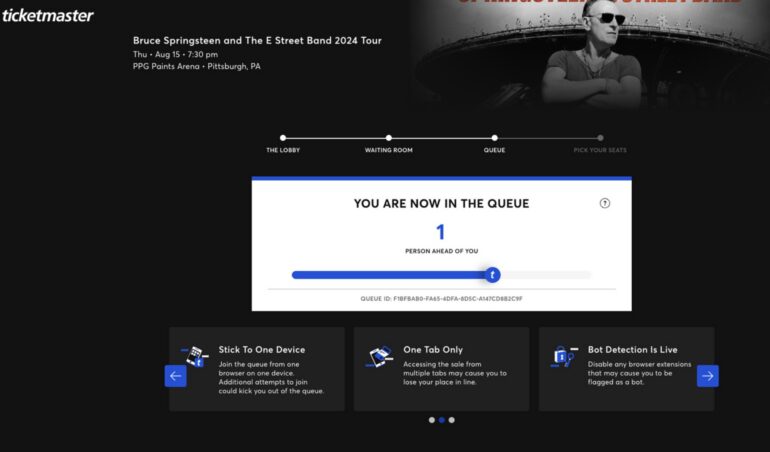
Not making things any better…
Live Nation and Ticketmaster have been under fire quite a bit lately, after a jury found the companies liable for operating as an illegal monopoly following a lengthy trial that saw the Department of Justice striking a deal with the entertainment giant, while several states refused to settle.
Ticketmaster, which merged with Live Nation in 2010, controls the majority of tickets for live events. They do this through exclusivity contracts with venues that force them to use their platform to sell tickets, and in recent years have sought to grow their influence in the secondary (resale) ticket market by keeping tickets on their own resale platform to shut out competitors like StubHub and many others.
But Live Nation also maintains its dominance through ownership of many venues, including nearly 78% of the country’s large outdoor amphitheaters, as well as through exclusivity contracts with non-Live Nation owned venues. These long-term contracts lock venues into using Ticketmaster and effectively shut out any competition they may face. And because Live Nation ALSO owns artist management and promotion companies, they’re able to blacklist venues that don’t use Live Nation and shut them out of the marketplace.
(We’ve outlined before exactly how much control Live Nation has over pretty much every level of the live music industry, from venues and tickets to artist management and promotion, so if you want to read more about that you can find it here).
It’s a domination that has served Live Nation well: In 2025, the company reported revenue of $25.2 BILLION, a nearly 10% year-over-year growth from 2024, with $3.1 billion of that coming from Ticketmaster.
That’s part of the reason the lawsuit was filed by the Biden administration back in 2024, and at the time Attorney General Merrick Garland laid out the case for breaking up Live Nation and Ticketmaster:
“We allege that Live Nation does not maintain its dominance in the entertainment industry by staying ahead of its competition on the merits. We allege that Live Nation controls the live entertainment industry in the United States because it is breaking the law…
We are here because that conduct, as we allege, is anti-competitive and illegal.
It is time for fans and artists to stop paying the price for Live Nation’s monopoly. It is time to break up Live Nation and Ticketmaster.”
With the jury’s verdict, Judge Arun Subramanian will now decide the consequences for the companies, which could include monetary damages, injunctive relief forcing them to change their business practices, or even ordering a breakup of Live Nation and Ticketmaster (though I would say that’s unlikely).
Since coming under increasing scrutiny, Ticketmaster and Live Nation have been trying to take steps to improve fairness for customers. Starting last year, the company began using “all-in pricing,” meaning that listed prices reflected all fees so that there weren’t any surprises at checkout.
They’ve also been increasingly using verified fan systems to ensure that tickets aren’t being scooped up by bots, as well as a virtual “queue” to ensure that bots aren’t able to get in to buy tickets before actual fans have a chance.
How that queue works, though, has recently become a topic of controversy after the Ticketmaster CEO admitted that their system isn’t random – but didn’t give any additional information about how it works.
If you’re somehow not familiar with Ticketmaster’s queue system, it acts as a virtual line before you’re actually able to buy tickets. When you log on, you’re first placed into a “waiting room,” and once tickets go on sale you’re given a spot in the queue. A limited number of fans are then let in to actually buy tickets at a time, theoretically creating a more orderly process and ensuring that bots aren’t able to jump to the front to get all the tickets.
Of course there’s not a lot of information about how positions in the queue are determined, but recently the Ticketmaster president set off a firestorm after confirming that queue positions are not randomly assigned, as many seemed to believe.
The comments came as part of an interaction between a user on X (Twitter) and Ticketmaster president Saumil Mehta. The user was complaining about the queueing process, noting that her mother’s account always gets a higher position in the queue from her account, regardless of when the two accounts logged in:
“Considering we have joined over 50-100 sales from each account and our queue positions have remained consistent, it is hard to believe these queues are randomized from the waiting room.”
Mehta responded to her tweet, confirming that the queue is NOT, in fact, randomly assigned – but offering no clarification on how a user’s position in the queue is determined:
Naturally, this led many to speculate that Ticketmaster uses an account’s buying history to prioritize their position in the queue, choosing to favor high-volume buyers over those who don’t use the platform as much, though Mehta also denied that that’s the case:
So how are positions in the queue assigned if it’s not random and it’s not based on a user’s transaction history? Well, that’s the question that Ticketmaster seems not to want to answer. Mehta has been asked several times, but has said only that he’ll be back soon with an answer:
Whiskey Riff also reached out to Ticketmaster yesterday in an attempt to get clarification on his comments, and how the queue positions are assigned, but so far have received no response – though we’ll definitely let you know if that changes.
It seems like the entire situation just illustrates one of the major problems that Ticketmaster faces: A lack of transparency leaves fans wondering whether the system is rigged against them, and public comments like this do nothing to convince them otherwise.