


One might be under the impression that pretty much all snakes could easily take out pretty much all spiders. Sure, you might have a mismatch with a tarantula and a juvenile snake, but on the whole, you have to think that snakes would have the advantage?
But… that’s not always the case.
Arachnids can and will prey on certain reptiles, especially in places like Australia where spiders can grow quite large and fearsome. But even in America, there are examples of spiders making short work of snakes.
And this one was caught on video.
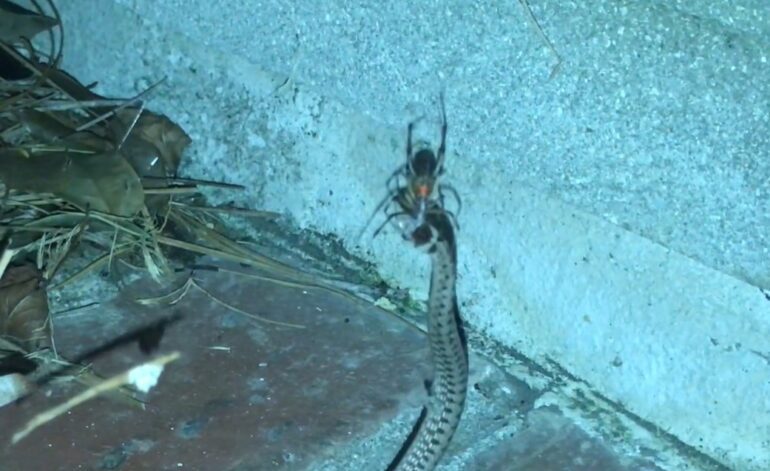
A few years ago, the owner of a house in Georgia captured an epic battle between a brown widow spider and a brown snake. Black widows are widely known as one of the most dangerous on Earth, but in general that’s a loose term given to all Latrodectus, which counts 34 species. Spoiler alert, the brown widow isn’t any nicer…
The brown widow spider is a close relative of the infamous black widow, and while it’s venomous, it’s generally less dangerous than its darker cousin. Originally from Africa, brown widows are now found throughout the southern United States, especially in Florida, Texas, and California. They’re easily recognized by their tan to dark brown bodies and signature orange hourglass marking under the abdomen.
The snake was probably trying to grab an easy meal when it found itself stuck in the unbreakable binds of a spider web. You don’t assume that a spider web is strong enough to catch a snake, but this is one of the strongest ones I’ve ever seen. Just the thickness of the strands gives me the creeps…
But once the spider is able to crawl down and deliver a lethal dose of venom, it’s all over… the snake seizes up, and it’s just a matter of getting it wrapped up in its web and digging in. Dinner is served. Another win for the spiders and more second thoughts on my understanding of the food chain.
One of the comments summed it up best… if spiders were the size of dogs, we’d be in some serious trouble.
More On Brown Widow Spiders
As I mentioned above, the brown widow is closely related to the black widow, though it poses a significantly lower risk to humans.
Originally believed to be native to Africa, it has established populations in tropical and subtropical regions worldwide, including the southern United States and California… and it actually displaces native black widow populations.
They thrive in urban environments and build messy, irregular cobwebs in dark, sheltered spaces. Common hiding spots include the undersides of outdoor patio furniture, barbecue grills, mailboxes, playground equipment, and eaves.
Identifying Brown Widows
The most reliable way to identify a brown widow infestation is by their egg sacs. Unlike the smooth, round egg sacs of a black widow, the brown widow’s sac is covered in pointed silk tufts, making it look like a tiny sandspur or a naval mine.
More Venom?
While brown widow venom is actually more toxic drop-for-drop than black widow venom, they inject significantly less of it during a defensive strike. Bites typically cause localized pain, redness, and swelling at the site, but rarely lead to the severe, systemic muscle cramping associated with black widow envenomation.
Brown widows are extremely timid and non-aggressive. When disturbed, their primary defense mechanism is to retreat into their web funnel or drop to the ground, pull their legs in, and play dead.
Bites almost exclusively occur when the spider is accidentally crushed against the skin.
Praying Mantis Grabs Hold Of A Snake
Thought the spider was pretty cool? How about this…
Praying mantises are insects that are known for their distinctive appearance and predatory behavior. These insects are found throughout the world and are famous for their unique ability to turn their heads almost 180 degrees to look around.
Praying mantises are carnivorous , meaning they prey on a wide range of other insects and small animals. Their diet can include flies, crickets, moths, and even small vertebrates such as lizards and birds.
Praying mantises are known for their hunting abilities, using their powerful front legs to grab and hold their prey. Once they have caught their prey, they will consume it alive, often starting with the head.
While it may seem unlikely for an insect, some species of praying mantises are known to take out snakes.
A snake is seen slithering along a log as it comes across a praying mantis. The mantis squares up and is ready to take on the snake, that although is small, it is much longer. The snake recognizes the danger and decides to proceed with caution. It tries to get around the insect, but is unable to evade it. In one final attempt, the snake tries to get by but gets latched onto by the praying mantis.
The mantis begins to eat the snake as it is still fighting to get out of the tight grip. Eventually, the snake can’t fight and completely gives in as the mantis happily feeds away.
That is wild.