

Bears and elk are both some of the coolest animals that roam our forests. Any interaction with them is spectacular, but seeing these two different animals in the same scene is must-watch footage for me. Two of American’s most awe-inspiring animals? Sign me up for that every day of the week.
Grizzly bears are highly opportunistic omnivores whose diets shift dramatically based on seasonal food availability, geographic location, and caloric needs prior to hibernation. While coastal grizzlies consume large quantities of salmon, inland populations… primarily those in the Greater Yellowstone Ecosystem and the Canadian Rockies… rely on a diverse mix of grasses, roots, berries, insects, and ungulates.
Believe it or not, they actually eat far less meat than you’d expect. But when they do get the opportunity to chow on a bison carcass, or run down an elk calf, they’ll gladly take it. I mean, it’s hard to blame them for that… elk is widely considered the best game meat out there by many.
The Elk Diet
Elk represent a critical, nutrient-dense protein source for inland grizzly populations and factor into their diet through several distinct avenues… one being carrion. When grizzlies emerge from hibernation in early spring, vegetation is scarce. Winter-killed elk provide an essential, immediate source of fat and calories to replenish the bears’ depleted energy reserves.
During late spring and early summer, grizzlies actively hunt newborn elk calves. The bears use their acute sense of smell to locate calves hidden by their mothers in brush and tall grass, securing a high-value meal with minimal energy expenditure. Grizzlies will also try to steal fresh elk kills from other apex predators, most notably gray wolves and cougars. A dominant grizzly will use its sheer size and aggression to drive an entire wolf pack off a fresh elk carcass.
While physically capable of taking down a mature elk, grizzlies rarely hunt healthy adults because a sustained chase requires too much energy and carries a high risk of injury from hooves and antlers. Instead, they opportunistically target sick, injured, or aging elk, occasionally ambushing them in deep snow, mud, or water where the elk’s mobility is severely compromised.
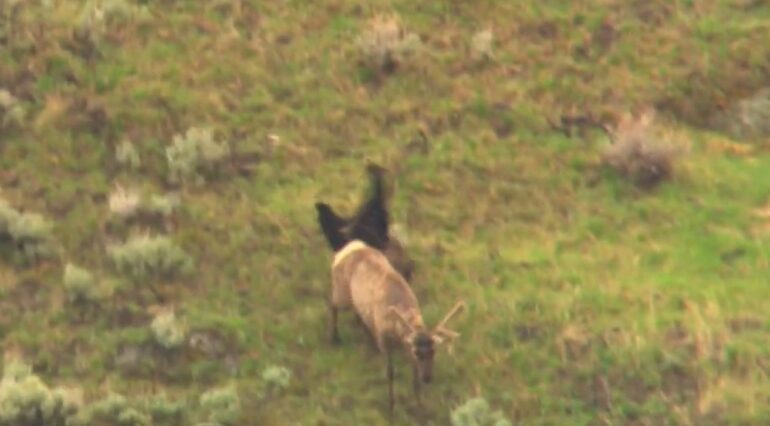
That’s what this grizzly was thinking when he came across this wounded bull elk on a hillside. The grizzly even had the uphill advantage, or so he thought.
The grizzly jumps and latches onto the hind quarters of the elk, who takes off downhill for the river. Immediately the grizz falls off and cartwheels down before catching himself and continuing the chase. The wipe out gave the elk just enough space to get down into the river swimming away to its safety.
What a wild encounter to see.
Our elk lives to fight another day… at least for now. That bite out of backside probably lefty a gnarly gash that may limit mobility and expose it to possible infection. The odds aren’t great for our elk here…
But beyond ungulates like elk and moose, a standard inland grizzly diet is heavily subsidized by plant matter. They spend vast amounts of time grazing on sedges and digging for roots.
During the late summer and fall phase known as hyperphagia, their focus shifts entirely to maximizing caloric intake for the winter, driving them to consume tens of thousands of berries, whitebark pine nuts, or alpine army cutworm moths daily.
Grizzly Bear Joins Wolf Pack On Elk Hunt
Work smarter, not harder.
In the wild, it’s first come first serve, survival of the fittest, only the strong survive, and most critters will go to extreme lengths to make sure they get fed. But… even in the wild, there’s such as thing as freeloaders, and I’m not talking about scavengers.
One particular grizzly bear at Yellowstone National Park came up with a genius idea to follow along a wolf pack in search of its prey. And no, the grizzly was not there to make friends.
According to The Hill, this grizzly was following the Junction Butte wolf pack as they were in the midst of an elk hunt back in October of 2021. The wolves tracked down an elk, and when they captured it, the grizzly made sure it wasn’t gonna leave hungry.
It jumped in and stole the carcass, taking home a nice meal.
This “rare phenomenon” is known as kleptoparasitism, which is where one animal steals the resources of another animal/pack of animals.
The National Park Service (NPS) weighed in on the rare occurrence:
“This bear seems to have figured out that following the wolves in the morning will increase its chances of encountering a high-calorie meal.”
The NPS also said that wolves will typically yield for bears, because it puts their own safety at risk, knowing that they don’t stand much of a chance against the much larger creatures, and they simply wait their turn.
According to the NPS, it’s a rare occurrence because following a wolf pack around takes a lot of energy for the bear, but can be very rewarding, as an elk carcass is high in protein and fat, which is pivotal for hibernation.
“On the morning of October 21, 2021 visitors watching wildlife in Yellowstone’s northern range were amazed when they saw an adult grizzly bear seemingly hunting elk with the Junction Butte wolf pack. Wolves and bears typically compete with one another for prey, so why might this be happening?
Typically, wolves will yield to incoming bears. Since hunting is dangerous and often unsuccessful, it’s better for wolves to wait their turn at a carcass that has been usurped by a bear than it is for them to continue hunting.
From the bear’s perspective, it takes a lot of energy to follow a wolf pack around, but the reward is high if it successfully takes over a carcass. A fresh elk carcass is a wonderful source of fat and protein for a grizzly bear preparing for hibernation.
This bear seems to have figured out that following the wolves in the morning will increase its chances of encountering a high-calorie meal.”
Ever work on a group project where one dumbass doesn’t do any of the work, but still gets a good grade? This is nature’s version of that…