

As we push deep into June, the sun is blazing, water temperatures are spiking, and in some cases, those easy shallow patterns are drying up fast. Of course, there’s always a certain population of bass that will stay shallow year around, especially when they can find cover near laydowns, docks, and matted vegetation, but a good chunk of them are going to move out deeper.
I love skipping a jig under docks (or even a Coike lately), but oftentimes the biggest bass in the lake have already packed their bags and headed for deep water. They’re out there schooling up on river ledges, submerged roadbeds, deep brush piles and weedlines, or isolated cover, and they’re looking for cooler temperatures and an easy meal.
A lot of anglers will chase the early morning topwater bite, but after that dies, you have to leave the shoreline behind and get comfortable fishing offshore. It can be intimidating staring out at a massive expanse of open water, especially if you’re on a large fishery, but dragging the depths is exactly where some of the true giants live during the dog days of summer.
If you’re ready to stop getting skunked by the midday heat, here are five proven, tournament-tested techniques for triggering massive offshore bass when they retreat to the deep.
1. Deep Cranking
Fishing a deep crank can be a great way to catch them in the summer months, as a number of bass, especially some big ones, will push deeper where the water is a little cooler and the water has more dissolved oxygen in it.
The Setup: Grab a big deep-diving crankbait paired with a long, medium-heavy cranking rod and a low-gear-ratio reel for maximum torque. You’re gonna want a big and long, cranking rod with a moderate action, probably or 7 and a half feet or more, so you can get a good, long cast. The lower gear-ratio reel will help you not wind too fast.
Rapala DT 16 Crankbait – $8.79
Colors: Citrus Shad, Green Gizzard Shad, Big Shad
The Execution: Cast well past your target zone, crank furiously to get the bait down to its maximum depth, and intentionally crash the bill of the bait into the bottom. Deflecting the lure off rocks, shell beds, and submerged stumps creates an erratic action that forces nearby bass to instinctively attack. Look for ledges, deep points, creek channels, and offshore humps. If you’re in a big reservoir with some current, bass will often set up on the down-current side of the structure, waiting to ambush baitfish.
2. Stroking a Football Jig
Dragging a jig is standard practice, but “stroking” a heavy jig is how you fire up a completely dormant, uncooperative school of bass sitting tightly on a ledge.
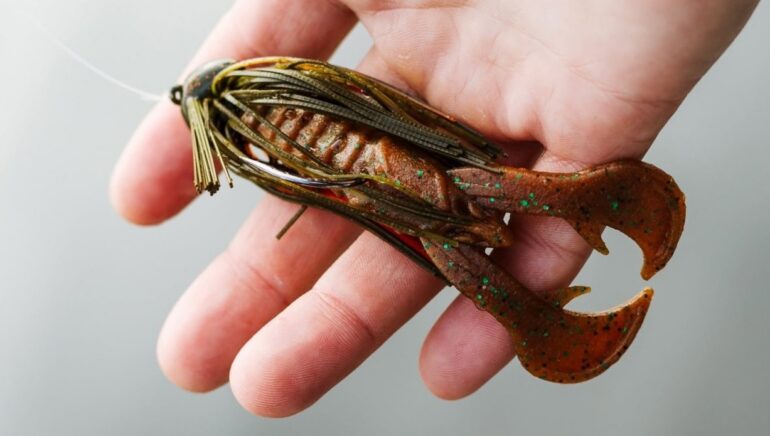
The Setup: A 1/2-ounce or 3/4-ounce football jig so you can feel it tight on the bottom paired with a high-action craw trailer. You’re gonna need a pretty stiff, heavy-action casting rod (somewhere in the 7’2″ to 7’6″ range) and heavy fluorocarbon line to drive that hook in deep water.
Keitech Tungsten Football Jig – $7.99
Colors: Brown Purple, Black Blue, Green Pumpkin Black
Colors: Goat, PB&J, Junebug
The Execution: Instead of dragging the bait, pop your rod tip aggressively from the 9 o’clock position straight up to the 12 o’clock position. This rips the heavy jig three to four feet off the bottom, after which you let it plummet back down on a slack line. The sheer speed of the fall mimics a fleeing crawfish or dying baitfish, drawing violent strikes as the jig sinks.
3. Dragging A Carolina Rig
When you are staring at a massive, featureless offshore flat and need to locate isolated rock piles or stumps, the Carolina Rig is the ultimate search-and-destroy technique.
The Setup: A heavy 1-ounce tungsten barrel weight separated from big worm or a creature bait by a 3-foot fluorocarbon leader and a heavy-duty swivel.
Rapala Crush City Hedgehog – $7.49
Colors: White, Black Blue Flake, Watermelon Red
The Execution: Cast as far as possible and use a slow, sweeping motion with your rod to drag the heavy weight across the bottom. The heavy sinker transmits the exact composition of the bottom up through your line, allowing you to “feel” when you hit a gravel patch or shell bed, while the weightless soft plastic floats naturally behind it. Old school, but it just works.
4. Ripping a Flutter Spoon
When massive schools of bass suspend off the bottom chasing large gizzard shad, traditional bottom baits will go completely ignored. A giant flutter spoon is the perfect solution.
The Setup: A massive 4-inch to 5-inch metal flutter spoon (often weighing an ounce or more) fished on heavy fluorocarbon.
Nichols Lake Fork Flutter Spoon – $9.99
Colors: Silver Chrome, Shattered Glass, Blueback
The Execution: Cast over the school, let the spoon sink all the way to the bottom, and aggressively rip it upward through the water column. Let it fall back down on a semi-slack line. The wide profile of the spoon causes it to violently flutter and flash as it sinks, perfectly imitating a dying, oversized baitfish.
5. Drop-Shotting Deep Cover
When the summer heat peaks, the water goes dead flat, and the offshore bass refuse to chase large reaction baits, you have to downsize and put the bait right on their noses.
The Setup: A spinning rod and light line paired with a drop-shot rig (a small finesse worm hooked 18 inches above a 3/8-ounce drop-shot weight). If you’re not fishing around any grass or wood, you can nose hook your soft plastic on a drop shot hook, but if so, opt for a 2/0 finesse Neko hook and you can tex-pose that hook point so it’ll come through that cover without hanging up.
Roboworm Straight Tail Worm – $3.97 – $4.99
Colors: Aaron’s Magic, Margarita Mutilator, Morning Dawn
Berkley Lab Series Flat Worm – $14.99
Colors: Violet Morning Dawn, Tactical, Ember Jelly Fusion
The Execution: Using your boat’s sonar, idle over a deep brush pile or ledge until you mark fish on the screen. Drop the rig straight down vertically into the school. Keep the weight completely still on the bottom and simply shake the slack in your line to make the small worm quiver in place until a lethargic bass finally gives in and eats it.
Honorable Mention: Minnow Shaking
This one comes with a bit of a caveat because you probably need a forward facing sonar setup to effectively fish a minnow offshore. You don’t need it, but you can be WAY more efficient and effective with it. In the summer months, bass will school up offshore, and prior to forward facing sonar, it took quite a bit of work to find them.
The Setup: I generally like a medium spinning rod, a ball jighead somewhere in the 3/16 to 5/16 range… up to 3/8 if you have really deep water, and I run 8-lb Sufix Revolve to an 8-lb leader (sometimes 6 or 10) on just about every spinning setup I have.
Rapala Crush City Mooch Minnow – $6.49 – $7.99
Colors: Electric Shad, Albino Shad, Shad
For a bigger profile, you can try the Freeloader.
Rapala Crush City Freeloader – $6.49 – $8.99
Colors: Electric Shad, Albino Shad, Shad
The Execution: Like I said before, you’re going to want to use your electronics, especially FFS, to locate the big schools, and there are a few places you can look first. The primary focus is offshore structure… ledges, steep drop offs, humps, points… the standard places you’d drag a bait. But they can also suspend out there in the middle of nowhere, so you just gotta look around.
*This post contains links through the Tackle Warehouse Affiliate Program. While all products are independently selected by our expert Riff Outdoors team, if you use these links to make a purchase, we may earn a commission.