


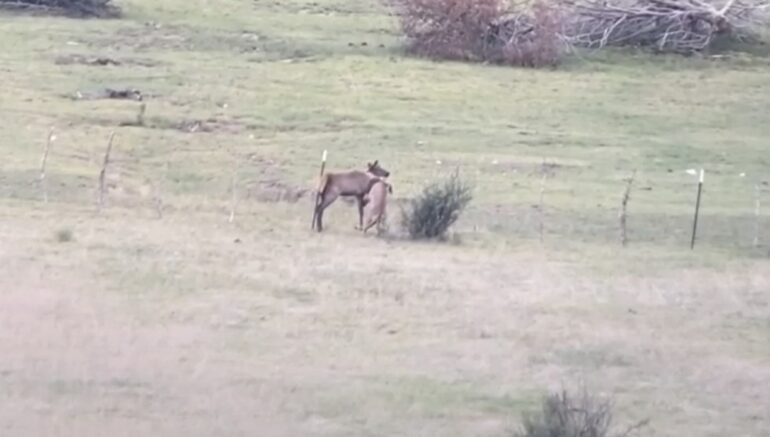
I would imagine that this would not be the way I would want to go out… but when you’re an elk living in the wild and rugged landscape of Arizona, there are no easy ways. In fact, the ironic reality is that the easy way is perhaps the most controversial… hunting.
Arizona’s topography is both diverse and challenging. Ranging from deep desert canyons to the dense ponderosa pine forests of the high country, it offers some premium habitat for both predator and prey. It is home to one of the most robust mountain lion populations in the United States, as well as a world-renowned herd of Rocky Mountain elk.
Unlike many states where apex predators were fully extirpated, Arizona has always maintained a healthy, continuous population of mountain lions. The Arizona Game and Fish Department conservatively estimates the state’s mountain lion population to be between 2,500 and 3,000 independent adults. They are highly adaptable and occupy roughly 45,000 square miles of the state, which is good for about 40% of the state.
While they are most dense in the rocky rim country, mountains, and canyonlands, they can be found anywhere there is a stable food source… basically wherever deer and elk go, the lions will follow.
When it comes to elk, Colorado and Montana seem to get all the press, but serious elk hunters know that Arizona is famous for producing some of the largest, trophy-quality bulls in the country.
Arizona boasts a thriving population of roughly 35,000 to 45,000 elk, and the vast majority of Arizona’s elk are concentrated in the central and eastern high country, specifically along the Mogollon Rim, the White Mountains, and the Coconino National Forest around Flagstaff.
Elk vs Mountain Lions
An adult bull elk in Arizona can easily weigh between 700 and 900 pounds, while cows typically weigh between 450 and 600 pounds. This massive size disparity makes hunting them a high-risk endeavor for a mountain lion, which usually tops out at 130 to 160 pounds.
And unlike wolves, mountain lions are solitary hunters who rely on stealth to ambush their prey… they don’t really chase them down. As you’ll see here in a minute, they rely on absolute stealth, explosive power, and lethal precision.
A mountain lion will generally use rocky outcroppings, canyon ledges, and thick timber to get as close to a grazing elk as possible without being detected. They possess heavily padded paws that allow them to move in total silence, but like most big cats (or even a house cat hunting a mouse), they will patiently stalk until they are close to their target. Sometimes, they will just camp out behind cover near a path, just waiting for an elk to mosey on by.
But once in range, the lion launches into an explosive sprint. They can cover 50 feet in just a couple of seconds, leaping directly onto the back or shoulders of the elk before the animal has time to bolt. The cat uses its powerful front claws to hook into the elk’s shoulders and neck, pulling the animal’s head backward. The lion immediately drives its teeth into the back of the elk’s neck to sever the spinal cord, or bites down on the throat to crush the windpipe and cause rapid suffocation.
It’s certainly far more brutal that a .300 Win Mag to the heart… and this elk hunter caught it all on video in this once in a lifetime footage. I perfectly demonstrates some of the interesting facts that were laid out int he intro.
The video shows a herd of elk grazing around some open fields (caption said it was public land) when a mountain lion decides to mount an attack. It was basically an all-you-can-eat buffet for the big cat, who had plenty of potential elk to choose from, but honed in on what looks to be a smaller cow, one that it thought would be an easy target.
We mountain lion darting across the field and chasing an elk behind a patch of trees. After a moment, the elk and big cat coming sprinting back out onto the field, and the elk sees a potential escape route over a barbed wire fence.
This is one of those situations where the idea wasn’t all that bad, but the execution was extremely poor. In fact, once the elk makes the break for the fence, the mountain lion gives up. As I explained above, a mountain lion isn’t built for a long chase, and it appears to be ready to pack it in and try again another time. That is, until the elk’s misstep…
The elk tries to jump up and over the fence to join the rest of its herd mates and gets caught in the barbed wire of the fence. The mountain lion immediately goes back to the chase, and pounces right on the elk’s back. The claws dig in, the teeth sink in, and it’s game over in short order.
Jerritt Wybron posted the video onto his Instagram account, with the caption:
“Right place, right time! Once in a lifetime moment. Absolutely incredible that I was able to capture this rare moment on film. The image and screams from the elk are permanently burned into my head.
Growing up hunting lions, I have nothing but respect for them. They are incredible animals and hunters. That being said, this cats days are numbered…”
Love the threat directed towards the mountain lion there at the end, and I also love that Wybron decided to overlay the instrumental “Destroyer of Worlds” from the blockbuster film Oppenheimer.
Trail Cam Captures A Buck Following A Mountain Lion
What in the? Aren’t the predators supposed to chase the prey? Isn’t the deer supposed to be afraid of the predators?
I guess some Disney type stuff is going on here…
Mountain lions are one of the most dangerous and elusive predators in the wild. They can weigh up to 200 pounds and be over 4 feet in length.
They are known for their stealth, agility, and efficiency as hunters. Powerful runners, they are capable of reaching speeds of up to 50 miles per hour, making them one of the fastest land animals in the world. Cougars also have powerful jaws and sharp claws, which they use to grab and hold onto their prey while they deliver the killer bite.
Also known as cougars, they are solitary hunters and typically hunt at night, using their stealth and agility to stalk and ambush their prey. Much like other big cats, they will often lie in wait and then pounce on their prey from behind, delivering a powerful bite to the back of the neck. They are capable of bringing down animals as large as elk, but their favorite prey is typically deer.
Which is why this trail camera caught something that just doesn’t make sense.
A cougar is seen walking on by, but immediately following it is a deer that is growing a nice set of antlers. Like… following RIGHT behind it.
Normally, this deer would be nowhere close to this killer, unless it was already too late. Regardless of any circumstances or time of year, they are mortal enemies, if such a thing truly exists in the wild.
I mean, it almost looks like they’re just hanging out in the woods together, taking a nice stroll. This is pretty unexplainable, but nevertheless, a very cool catch on the trail camera.