


Wolves have long been one of the top predators in North America, having once roamed over 2/3rds of the continental United States and pretty much all of Canada. They have few natural predators and can take down creatures many times their size by pack hunting.
They rely on a devastating combination of marathon endurance and burst speeds of up to 40 miles per hour to exhaust and overwhelm their prey. Rather than depending on stealthy, explosive ambushes like big cats, wolves are built for prolonged pursuits and win their hunts through a war of attrition.
While they certainly close the distance at roughly 40 miles per hour for the kill, a wolf’s true biological advantage is its stamina. They possess massive lung capacities, long legs, and large, shock-absorbing paws that allow them to maintain a steady cruising trot of about 5 mph for hours on end. A pack can easily cover 30 to 50 miles in a single day while tracking herds.
Brilliant Hunting Strategy
When a wolf pack approaches a herd of deer or elk, they deliberately spook the animals to force a stampede. They use their moderate pursuit speed to pace the herd, actively scanning the running animals for any individual that is limping, lagging behind, old, or very young.
But once a vulnerable target is isolated, the pack shifts gears and the main goal becomes very simple: keep it running. Wolves will chase their prey over miles of rugged terrain or through deep snow.
Pack members will often take turns running at the front of the pursuit to conserve their collective energy, while the massive prey slowly depletes its own oxygen and adrenaline. They essentially swap lines like a hockey team… always bringing on fresh legs.
When the target is finally exhausted and its pace falters, the wolves utilize their 40-mph burst speed to close the final gap. Because a single wolf is significantly smaller than an adult elk or moose, they do not usually go straight for the neck of a running animal.
Instead, they use their speed to dart in and attack the hindquarters, delivering tearing bites to the hams and legs to physically cripple and slow the animal until the rest of the pack can swarm and pull it to the ground.
But if you want to see that speed in action, look no further.
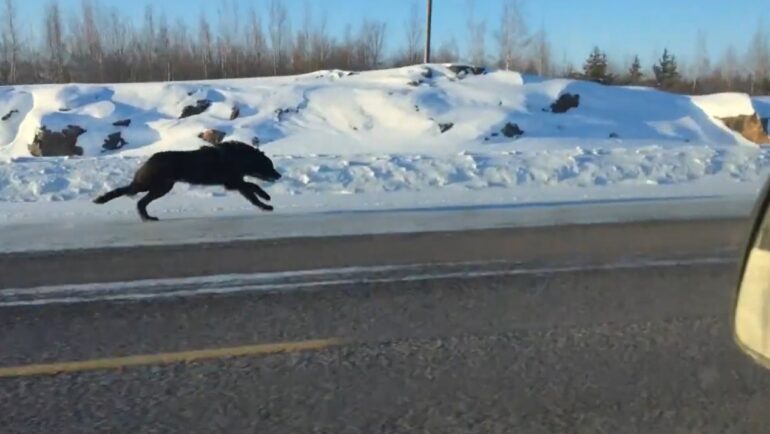
You can see just how fast that is in a video captured by a woman headed to work in Behchoko, Northern Territories, Canada a few years back. She noticed the wolf sprinting down the side of the road while behind it and hurried to catch up, which was a bit harder than you’d expect due to the icy road conditions, but really due to just how fast this guy was going.
He was flying.
I wish she would have showed the dashboard so we could gauge the speed, but either way there’s no doubt this guy was moving at or near that 40 mph top speed the experts say they have.
Stealing From A Sleeping Brown Bear
Don’t poke the bear…
Really, wolves and brown bears aren’t that different. They are both apex predators, who live to hunt and eat. They are both incredibly smart and strong compared to most of the animal kingdom, and both are fairly territorial especially with their food.
The real difference is size. These two are European sub-species, relatives of the wolves and brown bears in North America. These bears can weigh up to 500-pounds while the wolves max out around 80-pounds so a massive difference when it comes to a fight and competitive advantage.
This wolf is seen approaching a sleeping bear. You notice the bear is laying near down near something that is seemingly buried, AKA a prized possession.
Brown bears love to bury their kills and come back at another time for meals. Big cats like mountain lions and bobcats do the same. Often times other animals will try to claim the food as their own, but that’s an easy way to start a fight in a hurry… especially when your target belong to a bear.
This wolf, despite being on the young and skinny side (almost looks like a coyote), has some serious balls, though. He’s going up to a brown bear that is directly on its kill, thinking it’s going to steal a meal from right under his nose.
The bear quickly wakes up and is not impressed. I mean, for an animal that runs hot to begin with, this is a terrible way for him to wake up.
The wolf proceeds with caution but the bear simply stands on the kill and grits its teeth at the wolf as if to say “try me.”
The wolf tries multiple angles but has no luck at all and is eventually chased off.
It ain’t easy trying to rob a bear… but hey, can’t blame this hungry fella for trying.