

Mountain lion vs mountain goat… a chess match between two of nature’s most iconic mountain creatures.
When you live in some of the most rugged and demanding terrain in all of North America, it can be a blessing and a curse. Of course, these animals have spent thousands of years adapting to the conditions, but that doesn’t mean it is easy. During the cold weather seasons in the mountainous terrains of Western North America, food can become more scarce, temperatures drop into freezing, snow makes it more difficult to navigate, but these animals are built for it.
While there is a couple hundred in the greater Yellowstone area, mountain goats in North America are primarily found in Alaska and British Columbia, as well as the Rocky Mountains and the Cascade Range. While they look perfectly at home in the park’s rugged peaks, mountain goats are actually an introduced, non-native species in the Greater Yellowstone Ecosystem.
During the 1940s and 1950s, wildlife agencies introduced mountain goats into the mountain ranges of neighboring Montana to establish new populations for sport hunting. Over the decades, these highly mobile herds naturally migrated south, eventually crossing the park boundary and establishing themselves in Yellowstone’s northern and north-western alpine zones (such as the Gallatin Range). Because they share the exact same high-altitude habitat and forage preferences as Yellowstone’s native bighorn sheep, park biologists closely monitor the goat population to ensure they do not outcompete or displace the native sheep.
Mountain goats are masters of navigating the steepest and most treacherous terrains. They possess a dense, double-layered white coat that provides severe weather insulation and acts as natural camouflage against winter snow and high-altitude glaciers, allowing them to withstand temperatures plummeting to -50°F. Both males (billies) and females (nannies) grow sharp, dagger-like black horns.
Despite their nimbleness, mountain goats are quite large, and quite jacked. If you’ve ever seen one, the term “built like a brick outhouse” comes to mind. Adults can weigh between 100 to 300 pounds and stand about 3 to 4 feet tall at the shoulder. This size, combined with their powerful muscles, allows them to dominate the rocky slopes they call home.
Their hooves are specially adapted with a hard outer shell and a soft, flexible pad that provides the traction needed to scale sheer rock faces. This adaptation enables them to live and thrive in some of the most inaccessible places on Earth.
Inaccessible to… mountain lions?
Mountain lions are much more widespread than and adaptable than mountain goats, roaming from the Canadian Yukon to the southern Andes of South America, thriving in a variety of habitats. Isolated sightings occur all over the United States and a small population of the subspecies known as Florida Panthers live down in the Everglades region.
After being nearly eradicated from Yellowstone National Park during the aggressive predator control programs of the early 1900s, their populations have naturally recovered.
Unlike the park’s highly visible wolf packs, mountain lions are elusive, stealth-based ambush hunters. They heavily rely on Yellowstone’s rocky outcrops, thickly forested canyons, and rugged topography to stalk their prey… primarily elk and mule deer.
But much like the mountain goats, mountain lions use the terrain to their advantage. Their slender, muscular bodies and long tails, which help them maintain balance blend seamlessly with their environment and use it for cover. They are incredibly agile, capable of leaping up to 18 feet vertically and 40 feet horizontally in a single bound. Their retractable claws, powerful limbs, and acute senses of sight and hearing make them efficient predators.
Cats vs Goats?
We’ve established why these are two heavyweights of the mountainous region… but who has the advantage? It’s the mountain goats. They can simply go where others can’t, even some of the absolute best at navigating the terrain.
While a mountain goat’s primary defense mechanism is always going to be retreating to cliff faces so steep that predators simply cannot follow, mountain lions are one of the only apex predators agile and athletic enough to at least have a chance in this terrian.
Because both species favor rocky, rugged environments, their habitats naturally overlap in Yellowstone’s higher elevations. As we can see in the video, a mountain lion will use the boulders and cliff ledges to gain a height advantage, attempting to drop down on or ambush a goat from above before the goat can scale a sheer rock wall to safety.
However, it’s not that easy…
Hunting a mountain goat is incredibly dangerous for a mountain lion. If the ambush fails, there’s a pretty good chance that the big cat will take a tumble off a cliff. Mountain goats are able to lock those hooves into some of the steepest terrain imaginable, and as the video demonstrates, the meal just isn’t worth the risk. Plus, mountain goats are downright STRONG. If cougar ever finds itself in a position to launch an attack, a mature mountain goat is a formidable opponent.
A cornered goat will lower its head and aggressively drive its sharp horns upward into the cat’s neck and face. A single deep puncture wound from a goat’s horn can easily cripple or kill a mountain lion, making these interactions rare, highly calculated, and intensely high-stakes.
This extremely rare footage from Wolftracker gives us a clear picture of these two majestic creatures in action, and while witnessing it in the wild is uncommon… how it all plays it out is rather expected.
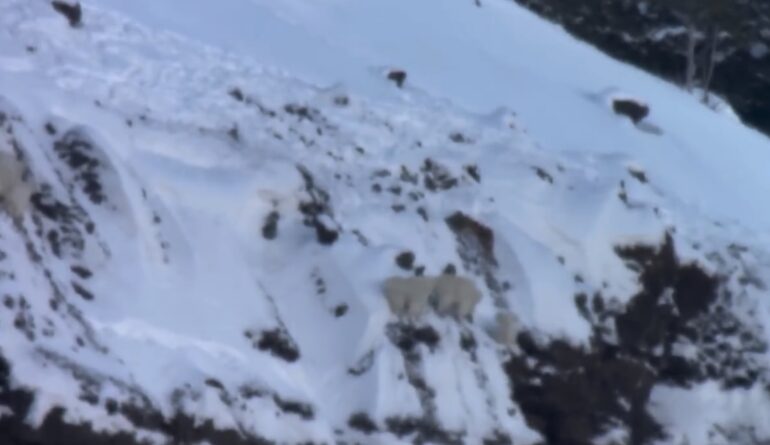
You can see a small family of mountain goats posted up on a very steep cliff face, out of reach for even the most nimble of mountain lions to get to. The big cat paces around, trying to find an lane to attack, but where the goats are located, it’s simply not gonna happen. The mountain lion may try and wait them out, but most likely, he’ll have to just move on and look for food elsewhere.
“Look carefully above the mountain goats to see a cougar stalking them along the mountain side. Our Winter Wolf Watch was lucky enough to get a rare glimpse of this big cat at work but the mountain goats survived in the end by perching on a tall and narrow cliff, leaving no room for the cougar to attack.”