


As it turns out, the United States isn’t the only country in the world where tourists get attacked by bison.
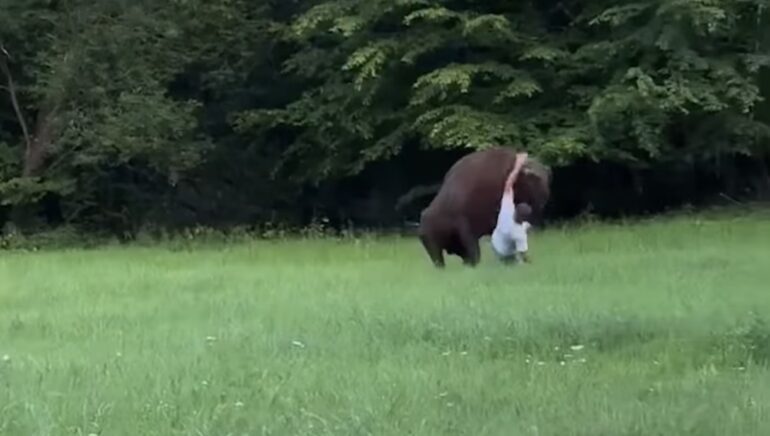
Thanks to a post from TVP World, we now know that even European tourists can be “tourons” (tourists that are morons). They shared a video of a man visiting the Białowieża Forest – a large forested area in between Poland and Belarus – getting attacked and nearly gored by a European bison.
It’s estimated that about 800 European bison call the forest complex and World Heritage Area home. And judging by this video, they too do not like it when people get too close to them. That’d be one of the many similarities they share with the American bison, which are often seen roaming the great Yellowstone National Park.
Here in the States, our National Park Service advises tourists to stay at least 25 yards away from bison, and to stretch that distance a bit during the “bison rut.” Mating season really gets bison in an aggressive and territorial mood, and we’ve already seen a couple of instances where that hasn’t worked out well for tourists in Yellowstone National Park.
While the bison rut for American Bison runs from June to September, the European Bison mating season is a bit different. It starts in August and stretches into October, with August and September being the most active months for Europe’s heaviest land mammal.
So it’s not all that surprising to see one of the bison near the Białowieża Forest showing some aggression towards a person that got too close. The person in this video that’s now going viral was even knocked down to the ground by the horned beast, and had to have someone in a car go off-roading in order to get the bison to retreat.
Check it out:
“A tourist was knocked to the ground by a European bison after approaching the animal too closely in Poland’s Bialowieza Forest. Witnesses said the bison lingered near the man until a passing car distracted it, allowing him to escape unharmed.”
Pretty scary… but I’d still say that the grandpa named Carl got it worse when he was gored and thrown into the air like a ragdoll earlier this summer at Yellowstone National Park.
Funny enough, the comment section on this post out of Europe is exactly like how the ones out of the United States tend to be. No one that came across the video gave much sympathy to the man that was attacked. Instead, they made sure to punch him while he was down… and criticized him for getting too close:
“Don’t mess with the bison.”
“Proof that cognitive dysfunction is a global problem.”
“He will stop bothering the animals from now on.”
“Never thought I’d ever say these words but the guy with BMW saved the day.”
“Good thing it was a tiny European bison. The American bison are huge.”
I don’t know if I’d categorize that bison in the video as “tiny,” but I guess that’s a decent attempt at spinning thing more positively, eh?
American Bison vs European Bison
So what’s the difference between American bison and European bison? Not all that much, but there is a few key distinctions.
Most people just throw around the word “buffalo” and call it a day, but if you do your homework, you know there’s a distinct difference between the American bison that roams Yellowstone and its European cousin, the European bison, also known as a wisent. There’s also two kinds of American bison… the plains bison (found at Yellowstone) and the wood bison, found in Canada and Alaska, but that’s a conversation for another time.
But the American bison rules the open plains and prairies, living as a dedicated grazer that mows down grass. The European wisent, on the other hand, lives in dense deciduous forests and operates as a browser, feeding mostly on leaves, shoots, and tree bark. Those different environments naturally created two distinctly different body types. The American bison is the heavier of the two, maxing out at a massive 2,200 pounds with a towering shoulder hump, a low-slung head, and a heavy, shaggy coat on its front half. The European bison tops out around 1,800 pounds but actually stands a bit taller on longer legs. It carries its head higher to reach up into the brush and features a much more uniform coat of fur from front to back, lacking that massive, signature prairie mane.
Neither of these animals are petting zoo material, and both will absolutely wreck you if you get too close. However, because the European bison evolved in dense forests, they tend to be a bit more elusive and skittish. The American bison, on the other hand, evolved as a massive herding animal on the open plains. They don’t hide; they just stand their ground and will happily bulldoze anything they view as a threat.
However, as we saw in the video above… the European bison is not to be messed with.