

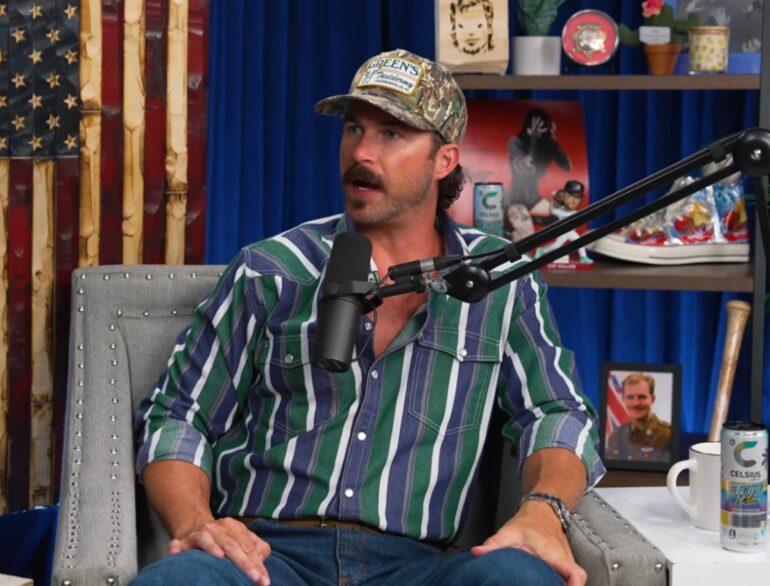
Riley is the guest on Theo Von’s This Past Weekend podcast, where he told Theo about his early days performing around his home state of Alabama.
Theo said that it’s harder to connect with the audience as he’s started performing comedy at bigger venues, and he asked Riley if that happened with music, too. And Riley didn’t beat around the bush,. He gave Theo a very direct answer, saying he does not think stadium shows are the way to go.
He used the stadium tour he opened for Luke Combes in 2023, explaining that there’s no way the people in the very back, top row of a stadium are “getting their money’s worth,” and of course, there are so many factors that go into a fan just getting to a show like that too, including beverage costs, driving and parking, which we all know is a huge hassle at these big concerts. Plus, for how much tickets cost these days, it’s really hard to justify spending that kind of money on nosebleeds, and I think that’s a lot of the reasoning for “blue dot fever” right now.
As someone who also hates stadium shows and would MUCH rather go to a small dive bar to hear live music than any sort of large venue, I think he nailed it and I could not agree more with everything he said:
“I did a stadium tour with Luke Combs and that’s too big. I feel like there’s no way the person in the far back top row is getting their moneys worth at a concert. And you also lose some sound too when you have to have two rows of speakers, one halfway through, there’s so much reverb and bounce back.
And then you think about how much of a pain is that show. The traffic to get in for a fan, and then you know to be able to find a place to park, and all that. Then you’ve got the fact that it’s also open air stadium, got weather issues and then your openers are starting in the daytime, so they don’t get the you know the full effect of the lights and everything.
So arenas have always felt like a great place for me, and you still have an intimate show, you still feel close to everybody, you feel like everybody got their money’s worth, but it’s still 20 to 25,000 people.”
Couldn’t have said it any better… I don’t think most artists would even admit that, but it is true, though I also have to imagine Riley would probably be happy to headline a stadium if and when the opportunity ever comes his way.
Of course, if an artist can make it to the level of being able to play a stadium, they’re always going to choose that because it’s easier for them to play one massive venue for a whole region, make a ton of money in one night and call it good as opposed to playing multiple smaller cities and increasing their time on the road and things of that nature.
Theo also brought up how it’s important for an artist to evolve to keep their fans, but Riley said he actually believes it’s the opposite, saying the internet has helped with that and he would advise young artists to not veer from what they do well, especially early on:
“What your guy said is a little bit not true, in the sense of… that may have been true 10 or 15 years ago before social media was relevant as it is, but now, if you do something well, like your stand-up videos, your podcast, whatever it lives forever.
So the next generation, you know, whereas when you had a song on the radio 10 years ago, it lived when it was on the radio, and then it went off and that was it. It was over. It didn’t live anywhere else. Now everything you do lives on the internet forever, so if you’re doing something well, I would really, especially like up-and-coming artists, I would advise against trying to do anything too different.
For me, what I always do is, I try to make sure I’ve got songs on my record that I’m writing from the same place I started writing from, that are very me. And then I try to take a few songs and write that are a little stylistically different, just to ease outside of my comfort zone a little bit.”
I have always appreciated Riley’s approach when it comes to staying true to the kind of music he does well and his roots, while also managing to appeal to the masses and become a commercial success with true country music, and he summed it up quite perfectly:
“I just think you don’t turn and run from something that was been successful.”
It’s hard to argue with that…
He went into talk about how his role in Marshals wasn’t too far off from who he was, because he felt like he was easing into it and it wouldn’t be such a shock to his fans, so I’m sure he will contiue to take on new roles as he grows as an actor and fans get to know that side of him too.
The full podcast is available below.