

Not exactly a Fourth of July anthem.
Martina McBride has caused quite a stir the past few days, after first being announced as a headliner for the Great American State Fair taking place this summer to celebrate America’s 250th birthday, before backing out just a day later following online outrage.
The fair is part of the celebrations being planned by Freedom 250, which is a non-partisan organization responsible for putting together all the festivities to celebrate America’s 250th birthday. The group was appointed by President Donald Trump execute his vision for the festivities.
However, there’s also a congressionally-appointed group called America 250 that was established in 2016 to organize events for the nation’s birthday, which has led to criticism of the Freedom 250 group as being an attempt by Trump to politicize the celebration.
The result has been that, so far, at least 5 of the 9 artists announced by Freedom 250 to perform at the Great American State Fair have backed out of the event, including of course Martina McBride.
In announcing her withdrawal, McBride claimed to have been misled about the event:
“I was presented with an opportunity to perform at a nonpartisan event but that turned out to be misleading. I asked lots of questions and was assured this was a nonpartisan event that was meant to celebrate ALL 50 states and also bring people together in a way that only music can.
I saw it as just a bigger version of so many state fairs I have performed at over the years, celebrating community and what makes each state special. Sounds fun, right? Wholesome even. Yesterday, things started changing and what we were told is, in fact, not what is happening. I’ve spent my entire career singing songs about real people with real issues.”
Of course now that she’s backed out of the event many on the right have criticized McBride, given that the fair isn’t meant to be a political or partisan event. And many have even pointed to the irony of withdrawing from a patriotic celebration when one of her biggest hits is “Independence Day.”
The 1993 hit is a popular song on Fourth Of July playlists. And obviously I know why people include it and why it’s a popular song for…well, Independence Day. It does take place on the Fourth of July, after all. And the chorus is enough to get any red-blooded American fired up:
“Let freedom ring, let the white dove sing
Let the whole world know that today is a day of reckoning
Let the weak be strong, let the right be wrong
Roll that stone away, let the guilty pay
It’s Independence Day”
And I mean, sure, if that’s the only part of the song you hear you might think that it’s a song about celebrating the Fourth of July. But the verses make clear that it’s about something very different – and much more dark:
“Well, she seemed all right by dawn’s early lightThough she looked a little worried and weakShe tried to pretend he wasn’t drinkin’ againBut daddy left the proof on her cheekAnd I was only eight years old that summerAnd I always seemed to be in the waySo I took myself down to the fair in townOn Independence Day”
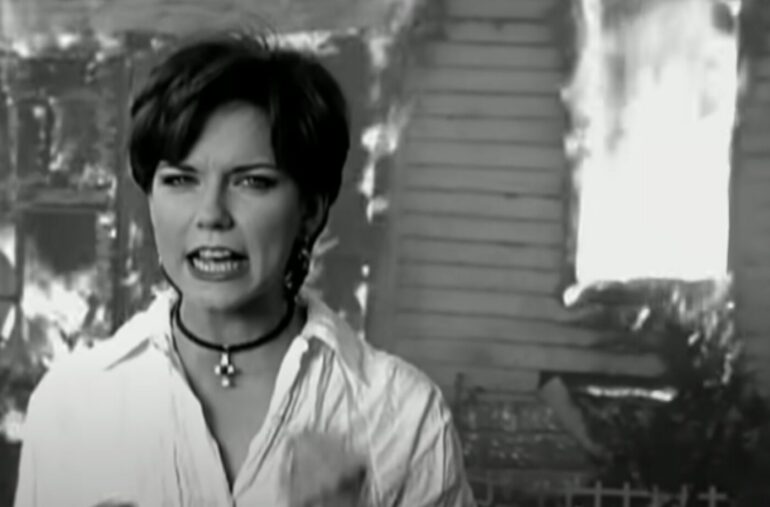
The song’s about an Independence Day, but not the kind that’s celebrated on the Fourth of July. It’s a dark tale about escaping from domestic violence from a child’s point of view, one where her mother eventually burns down their house and the daughter ends up getting sent to the county home after losing both of her parents.
Yeah, not exactly celebrating America’s birthday.
Of course it’s an incredible song. Written by Gretchen Peters, the song won the CMA Award for Song of the Year in 1995, and was named by Rolling Stone as one of the 100 Greatest Country Songs of All Time, despite only peaking at #12 on the charts.
But over the years, the song has somehow gained popularity as a patriotic anthem, being used by politicians at rallies, in Fourth of July celebrations, and it was even used by political commentator Sean Hannity as the opening music for his radio show – something Peters objected to since it’s not a political song, but is one about escaping domestic violence.
And as many have pointed out, McBride herself has embraced and benefited from the song being used as a patriotic anthem. Back in 2001, just weeks after the September 11th attacks, she delivered a fiery performance of “Independence Day” at Farm Aid on a stage adorned with American flag backdrops.
So it’s not exactly hard to see why the song is seen as a patriotic anthem – and some of that can be traced back to McBride herself – despite the song’s actual message.
Honestly, it’s always bugged me to be watching fireworks on the Fourth of July listening to a song like “Independence Day” that’s really about domestic violence, or even Bruce Springsteen’s “Born In the USA,” which is obviously an anti-war anthem about a veteran returning home disillusioned with his country after the Vietnam War.
Obviously it’s disappointing that Martina backed out of performing at the Great American State Fair. But if you were looking forward to seeing her perform “Independence Day” to celebrate our country…well, maybe pick a different song.