

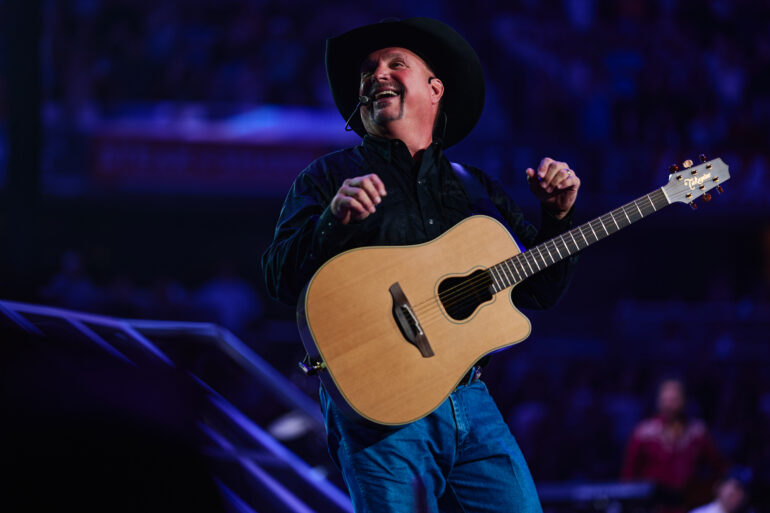
Garth helping out other artists…even if we have no idea who they are.
In this era of streaming, most people consume music on Spotify and Apple Music as opposed to buying physical media. In fact, I was thinking today that I don’t even have a CD player in my house, so I wouldn’t be able to play a CD if I wanted to. (Of course vinyl is making a comeback so I have a record player, but a lot of that’s nostalgia driven and not necessarily for convenience).
One artist has resisted the move to streaming, though, is Garth Brooks.
Why Isn’t Garth Brooks On Spotify and Apple Music?
Garth has explained his resistance to streaming in the past by claiming that he was taking a stand for songwriters, who get only a fraction of the royalties for streams that they do for physical sales like vinyl or CDs:
“I stick up for the songwriters because I’m freakin’ one of them. Everything I do for the songwriters, I do for myself.
I’m the most selfish guy you’ve ever met, okay? But if we don’t take care of these songwriters, what do you guys have to play? …
And I hope that songwriters want to get a Garth Brooks cut. One, because I hope that they think that it would be cool. But two, right behind it closely, I hope it’s because they know that if you’re a Garth Brooks songwriter, you’re going to get paid.”
Garth even briefly created his own streaming platform called GhostTunes back in 2014, but unsurprisingly it didn’t last long.
But now, if you want to hear “Friends In Low Places,” “The Dance,” or “The Beaches of Cheyenne,” Garth has an exclusive deal with Amazon Music so that’s the only place you can listen to his songs – unless you listen to Brooks Jefferson.
Who Is Brooks Jefferson?
While Garth’s version of his music isn’t on Spotify or Apple Music, there are versions of many of his biggest hits that are available by an artist who calls themselves “Brooks Jefferson.”
This mysterious artist has only one album on streaming platforms, and it’s a cover album of Garth songs called Strummin’ On Garth that was released back in 2015 (before AI artists took over). The album features everything from “People Loving People” and “What She’s Doing Now” to “Friends In Low Places,” “That Summer” and “Callin’ Baton Rouge.” But who exactly is this mysterious Brooks Jefferson?
Many people have speculated that it’s Garth himself, given the fact that he sounds similar to the original artist. Maybe a way for Garth to secretly get around his public opposition to streaming (and his exclusive deal with Amazon?)
Listening to his tracks though, it’s clear that it’s an impersonator (albeit a very good one) and not the real Garth. He’s such a good impersonator though, that he’s racked up millions of streams and 1.4 million monthly listeners on Spotify as fans have clearly decided that his covers are worthy substitutes for the originals.
But we still don’t know who Brooks Jefferson really is.
There’s no record of a “Brooks Jefferson” performing live tribute shows, no social media presence, and nothing in the credits for his album that would give us a hint as to his identity. SoundExchange, which is the organization designated by Congress to collect royalties from “digital performances,” i.e. streams, lists both the artist and the label for the album only as “Brooks Jefferson.” And it appears that Jefferson, whoever he is, hasn’t even registered his album with the US Copyright Office, or attempted to trademark his pseudonym.
(Obviously the copyright for the songs themselves is held by the publisher, but artists are able to copyright their sound recording of a song to prevent others from distributing their version).
A Google search for Brooks Jefferson likewise comes up empty for clues as to his real identity: In fact, the first photo that pops up is a picture of Tracy Byrd.
But in another interesting wrinkle to the saga, there’s another Garth Brooks impersonator on Spotify who sounds nearly identical to “Brooks Jefferson” who released many of the same covers around the same time as Strummin’ On Garth.
Are Dylan Miller And Brooks Jefferson The Same Person?
Is Dylan Miller really Brooks Jefferson? And if so, is Dylan Miller the guy’s real name?
Well, long story short…we don’t know. There’s no information on Dylan Miller out there either, and it appears that the only songs he’s released have been the Garth covers from 2015. (There are a couple of other Dylan Millers in SoundExchange, but it doesn’t appear to be the same guy).
So why did Brooks Jefferson and Dylan Miller drop Garth Brooks cover albums, without ever revealing their true identity, and just disappear?
As with everything, my guess is that it all comes back to money. Garth keeping his music off of Spotify creates a massive opportunity for someone else to fill the demand, and Brooks Jefferson was able to capitalize on everybody who went to Spotify searching for Garth’s biggest hits. When you search for “Friends In Low Places” or any number of Garth’s biggest songs, the Brooks Jefferson version is one of the first results to pop up.
It’s similar to Taylor Swift re-recording her own songs so that she owns the masters: You can’t put Garth’s version of his songs on Spotify because obviously he (or his label) owns the sound recordings, but you can release a “cover” version that sounds nearly identical to Garth.
Unfortunately though, there’s just really no information out there as to the true identity of Brooks Jefferson (assuming that’s not his real name, which I think is a pretty safe assumption). It seems he’s happy living in the shadows and collecting his royalties from the millions of streams he’s racked up on his one album. Gotta respect it.
But I would still love to know who it was and how he got the idea to release the album.
If you’re reading this, Brooks Jefferson, hit me up. I’ve been listening to your music for years and have no idea who you really are.