

Unfortunately, the use of AI in music is something that’s only going to get worse.
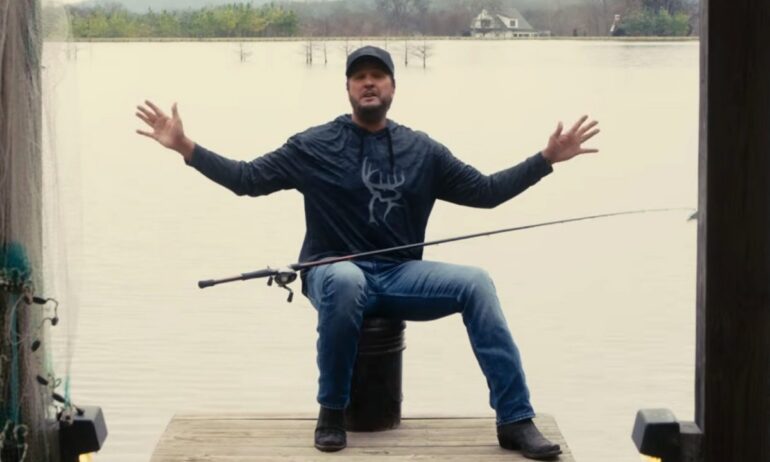
Luke Bryan has been criticized heavily for his recent track “Fish Hunt Golf Drink,” which he wrote with Chase McGill and Matt Dragstrem. It’s from his forthcoming album Signs, which is set to drop tomorrow, and funny enough, it was actually inspired by a conversation that Luke had with fellow country star Riley Green… but Riley has been very vocal about how he had nothing to do with actually writing it, if that tells you anything.
I haven’t really listened to Luke’s music in years, but he’s actually a great family man, he has a great sense of humor, and despite what people who hate bro-country may think, he’s actually one of the few artists who genuinely lives the country lifestyle. He’s from a small town in Georgia, his dad owned a peanut farm, and he’s an avid outdoorsman who loves fishing and hunting (and golfing and drinking).
But I definitely can’t defend these lyrics, and I can easily see why people think it could’ve been AI that helped write them:
“If it wasn’t for the tax man, wasn’t for the bills
If it wasn’t for the traffic in my windshield
If it wasn’t always somewhere to be
And my life was really up to me
If I could have it my own way, you know
Let me tell you how every day would go
Wake up, coffee
Camo, climb tree
Wet line, eighteen
Fish, hunt, golf, drink
All fall, all spring, all summer long
I’ll be livin’ it up and livin’ it on
A country boy’s dream
Fish, hunt, golf, drink”
Music is certainly subjective, there’s clearly an audience for simple, fun, and catchy country songs without much depth. It’s the kind of music you put on as background music on the boat or at a family party. But Luke Bryan remains adamant that he’s never, ever used AI to write a song.
Bryan had a lot to say about AI as a whole during a radio interview with Big D & Bubba this week. Bryan says he himself has never used AI for any of the songs he’s been part of, but he can’t say for sure if any of the outside cuts used it or not… not exactly a comforting sentiment, but Luke acknowledged that we can’t stop it in other aspects of life.
“Well first of all, my first frustration with it is, you know, you put a song out, and the narrative starts on… whether us as artists or writers AI’d it. I mean, my thing is, you’re not gonna slow down any processes of innovation in movies, music, daily life. You’re not going to slow it down.
Now, have I recorded song on this album that one of the writers that I don’t even know really well… I’ve got many, many writers on this album. All I can say is, I know the songs that I personally wrote, there was no AI involved.”
While not using it to write (I’d argue the most egregious form of using AI in music), he has used it in the demo process, explaining how he had some of his outside writers use AI to put his voice on a demo so he could hear how it sounds before agreeing to record it.
“But I’ll tell you this, let’s just say outside writers sent me a song, they would AI my voice when they pitched me the song so I could hear my voice and how I would sound.
What’s funny, you’ll love this, I call the writers and said, ‘Hey, throw my voice on this thing. I want to hear how I sound on it.’ Ten minutes later, my voice is on it, then I agree to record the song.”
To me, that’s a relatively “no harm, no foul” use of AI in the music business.
At the end of the day, Luke says his job is to try and connect with the audience, and he doesn’t think AI is able to do that… at least right now:
“How do you determine when it’s a good thing and when it’s a bad thing? My main thing is, at some point me being the artist, I’ve got to try to connect with my audience… you’ve still got to show up, put in the work, do the time, even if there are writers out there using AI things.
I don’t think AI is in a situation at this point where it’s ready to figure out how to emotionally connect. I still think whoever is steering the ship on that still has to try to write a song that connects.”
Bryan says the most frustrating part of all of it is having to explain himself to people after working incredibly hard to build his career without ever using AI. He says if you think a song was created with AI, the only thing you can do is not listen to it:
“We could go down a big ol’ soap box on this… the bottom line is, when people try to discredit what you’re doing, that’s when it gets frustrating.
When you do something, and you’ve got a 17-year-old kid claiming that I, or any artist, AI’d something, or they didn’t sign for real at the concert, then the person that’s worked their a** off for all these years has to go explain themselves, it’s like, what are we doing here? If you think the song is AI and you don’t like the song, just don’t listen to the damn thing.”
Personally, I hate the idea of AI being used in any part of the songwriting or recording process, and I hate that it’s even a topic of discussion, but it’s inevitably going to continue to be a huge conversation.
It simply sucks that we’re at this point, but like he says, no one can stop the “innovation” of AI and how it is going to continue to be integrated to society, we can only hope that the best artists will continue to do things the old fashioned way… the right way.
You can watch the full interview here:
AI or not, I think most of us can agree he has better songs than “Fish Hunt Gold Drink,” like the one Big D and Bubba mentioned at the end of the clip.
Titled “Praying by the Rules” it essentially is about someone who is rifling up prayers to God throughout the course of his day… at work, in the truck driving home, etc… and not just during specific “quite time” that is devoted to prayer.
Here’s a preview: