

For the first time in 30 years, NASCAR Cup Series points racing is officially returning to North Wilkesboro Speedway on Sunday.
The inaugural Window World 450 will be the first championship points-paying Cup Series race at the historic track since September 29th, 1996, and it’s been a long, nearly improbable journey to get there, but it’s been worth it.
There have hosted the non-points All-Star Race for the last three years, in 2023, 2024, and 2025, but having a points race there was the ultimate dream, and it’s finally happening.
And of course, the history in the area is rich with tales of moonshiners and the sport was shaped by men running from the law during the prohibition era, and they started souping up their vehicles to be able to outrun the cops, and alas, a uniquely Southern sport was born.
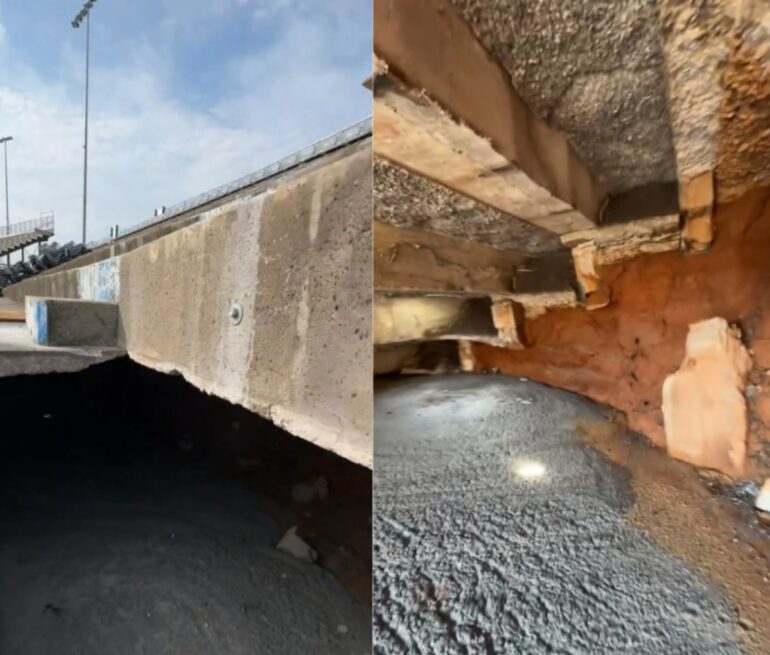
And in 2024, officials revealed that a supposed, a long-rumored moonshine cave was uncovered during grandstand cleaning and inspection. Staff at North Wilkesboro Speedway found cracks in the original concrete in section N, and began removing seats to see what was going on. And in that process, they discovered an open area of “approximately 700-square-feet” underneath that appears to be part of what was the aforementioned, rumored cave.
At the time, Steve Swift, senior vice president of operations and development at Speedway Motorsports, said that they had not located a still itself yet, but they did find a small cave and interior wall that would’ve “been the perfect location to not only make illegal liquor, but to hide from the law as well”:
“When we began renovating and restoring North Wilkesboro Speedway in 2022, we’d often hear stories of how an old moonshine still was operated here on the property under the grandstands.
Well, we haven’t found find a still (yet), but we’ve found a small cave and an interior wall that would have been the perfect location to not only make illegal liquor, but to hide from the law as well.
We don’t know how people would have gotten in and out, but as we uncover more, there’s no telling what we might find.”
They shared a couple photos earlier in the week, too, which didn’t really appear to be much of anything from what we could see on the surface, honestly:
Steve also said they’re still not totally convinced there isn’t more under the track, but they hadn’t yet had time to dig deeper and explore.
He did say that they hope to have Myth Busters, or some professional archeologists, come out and dig in really deep one day to see what they can find. And if they really think there could be more to it, I think that’s an absolute must in terms of honoring the legacy and lore of this NASCAR gem:
“It’s hard to say if the folklore and old stories that you constantly hear around here are true, but we are in the heart of what was once moonshining country, so who knows? We didn’t want to dig too deep into the cave, we unfortunately didn’t have time to be an archeologist.
There’s things under there you would see that makes no sense why they are there. We saw some things that were kind of weird, columns and an interior wall and it made us think of some of the stories we have heard in the past, there could be something to this hole.
It’s still plausible, and maybe Myth Busters can come out and investigate it one day.”
From a more realistic standpoint, it’s not crazy to imagine that they might’ve exaggerated this story in order to create excitement about the All-Star race, which was right around the corner when this happening two years ago.
And even if it’s not true, it’s not really all that far-fetched in terms of something like that being real, so like I said, I still hope they look more into it at some point in time. There’s been rumors about it for years among locals, so maybe they still (pun very much intended) know something we all don’t:
But according to Jeremy Markovich, who investigated the conspiracy for NC Rabbit Hole, he found some interesting evidence that might support the fact that a moonshine cave is exactly what it was. The dimensions of this cave stretched from Row 1 to Row 12, they pulled out about 600 metal seats out of the area, which had little-to-no support underneath it.
There was also a wall under the ground which ran parallel to the track, as well as some columns, which Steve Swift, Speedway Motorsports’ head of operations, says there’s no way to no for sure, but it was definitely suspicious:
“There were things underneath there that you wouldn’t normally see underneath a dirt-filled bank. Well, there’s that possibility. When we saw there was a larger cave, it became really plausible that some of these stories may be true.”
The speedway opened in 1947 as a 5/8 mile dirt oval, which had an uphill and downhill stretch. Enoch Staley, the original owner, supposedly ran out of money while grading it, and over the years, there were a lot of drainage issues at the track.
One time, it rained for a week straight before a race, and millions of earthworms took over the infield, and workers shoveled 20 gallons worth of them out. It rained again closer to race day, and they ended up having to delay the race another two weeks because of it… true story.
Swift admitted that water could have been the culprit for the degradation, though the void was larger than what might have come from erosion, and:
“Usually you’ll see the outskirts of red clay, which is what we see in the hole, right? Normally, if it’s an erosion problem, you’ll find that trailing of red stain where [the water] left. Where they were placed from an engineering stance, they weren’t to support the grandstand. It was kind of bizarre.”
Additionally, Paul Call, who was the only employee of the speedway for 60-plus years, went to check everything out while they were doing renovations, and when he saw crews working on suites above the grandstand with heavy equipment, he ran up there to stop it, Swift says:
“Paul, as fast as he could move, came up here and stopped us. He said ‘Do not get over this section. There’s stuff underneath here that you might fall through.'”
Unfortunately, Call has since passed and he never said why it was so important for them to leave all of that alone, but I have a few guesses…
Many believe it is a totally made up, untrue story, but the truth is, we’ll never really know for sure… and I think that’s part of the fun. In fact, a similar situation actually did happen at Middle Georgia Speedway. In 1967, feds found a moonshine still near Turn 3, which Markovich says “was accessible through a trap door underneath a ticket booth with a tunnel that led 17 feet underground. The still ran during races, mostly because the fumes from the cars masked the fumes from the mash. The track’s owner was arrested, but later found not guilty.”
Kind of iconic, honestly…
Swift says that he wished they could have found a “case of moonshine” to prove exactly what it was, but still, often times the idea of it all is much more fun than reality:
“I wish we could have found, you know, a case of moonshine. But sometimes the mystique’s a little bit more interesting than just finding the hard evidence.”
I personally believe that if it wasn’t hidden under the stands, it was hidden somewhere, and I don’t think a man like Paul Call, who I have to imagine knew a lot that he could never tell, wouldn’t react like that for no reason… but you’ll just have to be the judge for yourself.
The History Of Moonshine And North Wilkesboro Speedway
The track first opened in 1947 as a dirt track in rural Wilkes county, at the inception of the sport, and was later paved in 1958 and ran some of the biggest races in NASCAR up until the last Winston Cup Series race in 1996.
NASCAR clearly had humble beginnings in Wilkes and the surrounding counties, as it was then-known as the Moonshine Capital of America (and it probably still is, not gonna lie). In the prohibition era, people would run moonshine up and down the mountains, which often meant having to outrun the law so they could sell their illegal liquor.
Over time, they learned how to soup their cars up and make them run as fast as possible so they wouldn’t get caught, and eventually, the sport we know as NASCAR today was born.
The sport was not only a huge source of entertainment for people from all over the country who traveled to watch races there, but it also brought a lot to the economy in a town that, like so many small towns across the country, has seen a lot of its big industries leave.
Dale Earnhardt Jr. has also played a massive role in getting everything reopen, and he put out a fantastic series on his YouTube page called Roots & Revival series, which focuses on all of the history of the track, that I’d highly recommended watching for some more insight.