


Yellowstone National Park sees millions of tourists every single year, but only a lucky fraction ever get a front-row seat to this level of raw, untamed wilderness.
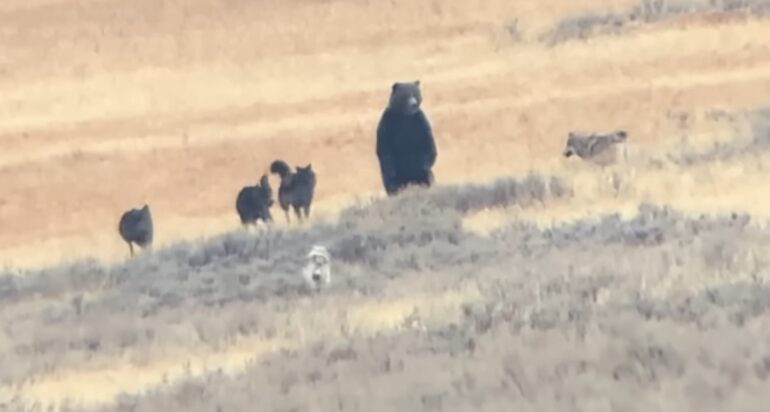
In an incredible video captured by tour guide Adam Brubaker of Tied to Nature, a lone grizzly bear in the Hayden Valley found himself on the wrong side of the tracks, so to speak. The footage opens with a curious grizzly standing on his hind legs to get a better look at a couple of wolves from the Wapiti Lake Pack. Instead of retreating, the bear confidently charges forward to investigate.
As Brubaker explains:
“I think more than anything, he wants to know what it is, and what’s going on. That’s why he was standing up. It’s the same thing with people; they don’t want to be surprised by anything.”
Unfortunately for the bear, the odds shifted almost instantly.
Two wolves quickly turned into three, then five, and suddenly, the grizzly was completely surrounded by fifteen wolves. While it looks like a terrifying showdown, Brubaker explains that this wasn’t an attempt to kill the massive predator. The pack was simply acting as nature’s bouncers. Essentially herding the bear away from their area like a pack of sheepdogs, but with a little more aggression:
“They’re just leading him away, so it’s not like they’re attacking him, but it’s saying ‘hey, we don’t want you here.’”
By circling the bear and taking turns nipping at his hindquarters, the wolves were aggressively herding him away from their turf. It was a clear, calculated message… you don’t belong here, and it’s time to leave.
Brubaker called the wild encounter a “once in a lifetime” sighting:
“I had the awesome opportunity to share this once in a life time wolf and grizzly sighting while on tour in Yellowstone today. This grizzly was foraging in the far end of the valley when the wolves started to cross his path.
The grizzly started standing up on his hind legs to get a better view of what was going on and then started to approach the wolves. Soon the rest of the wolf pack appears and escorts the bear into the trees.”
It is a brilliant reminder that out in the Last Frontier, the animals dictate the rules.
Yellowstone’s Wolves
Seeing a massive wolf pack go toe-to-toe with a grizzly is incredible, but it is a sight that was physically impossible just a few decades ago.
The wolves of Yellowstone are not just apex predators; they are a living, breathing testament to how quickly an ecosystem can heal when humans get out of the way. If you hear a howl echoing through the Lamar Valley at dawn, you are listening to one of the greatest conservation success stories in modern history.
Here is how the wolves reclaimed their throne:
The Eradication: By the 1920s, government-sanctioned predator control programs had completely wiped out Yellowstone’s wolf population to protect livestock. Without their main predator, elk populations skyrocketed, overgrazing the land and pushing the park’s ecosystem to the brink of collapse.
The Historic Return: In 1995, wildlife officials took a massive gamble. They transported fourteen gray wolves from Canada and released them back into the Yellowstone winter.
The “Trophic Cascade”: The reintroduction triggered an environmental domino effect. The wolves thinned out the massive elk herds, which allowed overgrazed willows and aspens to finally grow back. The new trees brought the beavers back. The beavers built dams, which created wetlands that supported otters, fish, and birds. By simply hunting, the wolves literally restabilized the park’s riverbanks.
A Controversial Predator
Today, roughly 100 wolves roam Yellowstone across ten distinct packs, including the famous Wapiti Lake and Junction Butte packs. For the millions of tourists who bundle up in the winter just to catch a glimpse of their dark coats against the snow, the wolves are a majestic symbol of the wild. But outside the park’s protective borders, the debate still rages.
Following their removal from the federal Endangered Species List in 2020, state-level management took over. To conservationists, they are the vital glue holding the ecosystem together. To many ranchers in the surrounding states, they remain an undeniable threat to their livestock and livelihood.
Regardless of where you stand on the politics, there is no denying the absolute power of this species. The wolves of Yellowstone are a profound reminder that true wilderness isn’t meant to be tamed—it’s meant to be respected