


At a certain point, you just have to tip your cap… even when somebody is just flat-out showing off.
In the hunting world, bagging a “double” with a single shot is the stuff of legends. We’ve all seen it in the movies—somebody goes full Robin Hood (or Princess Merida from Brave if you’ve got a little girl at home) and drops two targets at once. But out in the real world? It is incredibly rare.
You might occasionally hear a crazy story about a rifle hunter getting an accidental pass-through on a deer because they didn’t see the second doe standing in the brush behind their target. Aside from waterfowl hunters dropping two ducks with one scattergun blast, an intentional double is almost unheard of.
Especially with a bow.
Anybody who bowhunts knows that precision is everything. You spend countless hours in the backyard trying to split your own arrows on a target so that when a massive buck finally steps into your shooting lane, the shot is pure muscle memory. You don’t think… you just do. But you train to hit a target the size of an apple. You don’t train to hit two moving targets at the exact same time. But this guy is apparently on another level.
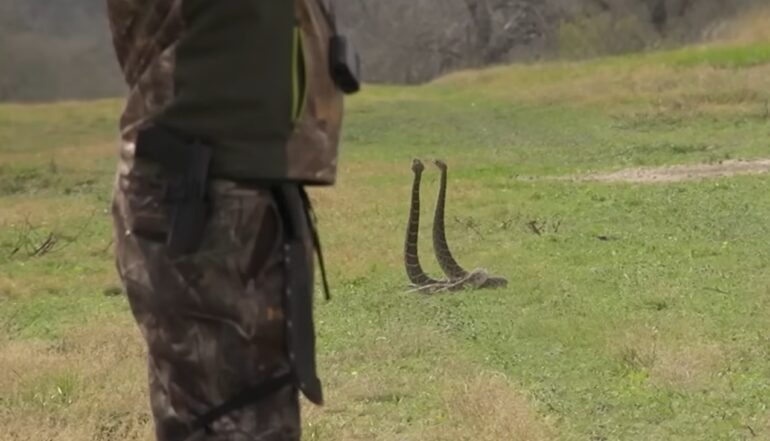
In a wild new video, a hunter is staring down a pair of rattlesnakes that are reared up together, heads high in the air. It’s unclear if they were a mating pair, or two males trying to posture for dominance, but our hunter here didn’t seem to mind either way. He missed with the first shot, expecting the snakes to vacate the area, but they were too wrapped up in whatever they were doing to get the hint. He stays completely frozen, bides his time, and waits for the exact millisecond their heads cross paths. He lets the arrow fly and absolutely nails it.
Bingo. One arrow, two rattlesnakes pinned perfectly together.
Granted, he was at a fairly close range, but threading a needle like that on two unpredictable (and venomous) snakes is undeniably impressive. The best part of the whole video might just be the hunter’s reaction—judging by the sheer shock on his face, it is pretty clear he didn’t actually expect to pull it off either.
Check out the wild footage below:
All About Rattlesnakes
Whether you love them or hate them, rattlesnakes are one of the most iconic and misunderstood reptiles in the Americas. And while they may have a bad reputation as aggressive killers, but the truth is, they just want to be left alone. Here is the breakdown of how they live, what they eat, and why you really don’t need to panic if you cross paths with one.
Where Do They Live?
When most people think of rattlesnakes, they picture a dusty desert in Arizona or Texas. While the American Southwest is definitely the rattlesnake capital of the world (Arizona alone has over a dozen different species), these snakes are incredibly adaptable.
You can find them all the way from southern Canada down to Argentina. Depending on the species, they live in swamps (like the Eastern Diamondback), thick forests (like the Timber Rattlesnake), and high-elevation rocky mountainsides. Basically, if there are places to hide and rodents to eat, a rattlesnake can figure out how to make a living there. Where I live here in Wisconsin, we even even have two species: the Timber Rattlesnake and the Eastern Massasauga.
Diet
Rattlesnakes are nature’s ultimate pest control. Their diet consists primarily of small mammals—mice, rats, ground squirrels, and rabbits. Occasionally, they will also snag birds, lizards, or amphibians if the opportunity presents itself.
They are ambush predators. Instead of actively chasing down a rabbit, a rattlesnake will find a high-traffic animal trail, curl up, and just wait. They use specialized “pit organs” on their faces that act like thermal cameras, allowing them to sense the body heat of a warm-blooded mouse running by in the pitch black.
When they strike, they inject venom through hollow fangs. This venom doesn’t just kill the prey; it actually starts digesting the animal from the inside out before the snake even swallows it whole.
Rattlesnake Fun Facts
How the Rattle Works: That famous tail isn’t filled with beads like a maraca. The rattle is made of keratin—the exact same stuff your fingernails are made of. It’s a series of hollow, interlocking rings that click against each other at lightning speed when the snake shakes its tail muscles.
You Can’t Tell Their Age by the Rattle: It is a common myth that you can count a snake’s age by the number of buttons on its rattle. A snake adds a new segment every time it sheds its skin, which can happen multiple times a year. Plus, the ends frequently break off on rocks or brush.
They Don’t Want to Bite You: Rattlesnakes do not view humans as food; they view us as massive, terrifying predators. Venom is biologically expensive to produce, and they don’t want to waste it on a human they can’t eat. That rattle is literally an evolutionary alarm system. It isn’t a challenge to fight; it is the snake politely saying, “I am down here, please don’t step on me.”
If you ever hear that rattle on a hiking trail, just stop, locate the snake, and take a few slow steps backward. Just give them their space, and they will happily give you yours.