

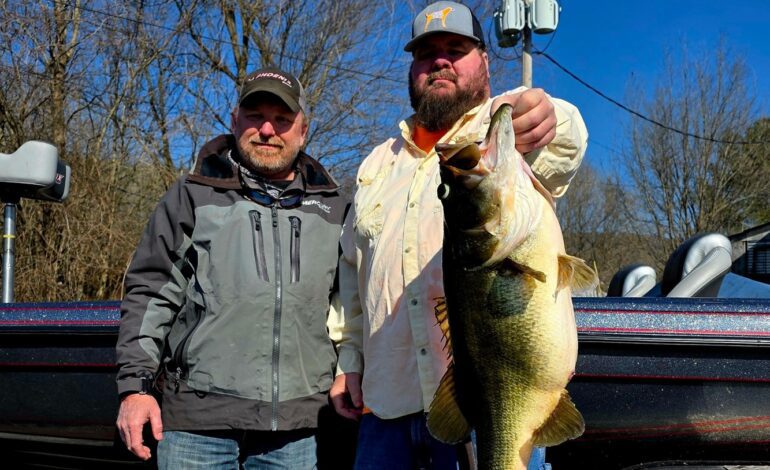
For the first time in over a decade, the state of Tennessee has a brand new largemouth bass record.
According to the Tennessee Wildlife Resources Agency, Darren Nunley caught the record breaking fish back in February on Nickajack Lake, a massive reservoir on the Tennessee Valley Authority river system. The monster largemouth weighed a whopping 15 pounds, 7 1/2 ounces, and stretched out to an impressive 27 7/8 inches in length. Just an absolutely massive fish, the kind you find more commonly in Texas and Florida. But if you’ve ever caught even a 5 pound largemouth, it’s hard to even fathom what a bass 3 times the size looks like.
The catch breaks a record held by Gabe Keen for over a decade. Keen caught a largemouth weighing 15 pounds, 3 ounces February 2015 (February appears to be the time to catch BIGS in Tennessee) on Lake Chickamauga. Prior to that catch, the record was held for more than 60 years.
Nunley was throwing a Chatterbait Jack Hammer, arguably the most popular bait country-wide for prespawn bass. His Shimano reel was spooled up 17-pound fluorocarbon line. The fish was weighed on a certified scale at a grocery store in Whitwell, Tennessee.
Gotta love the ol’ certified scale at your local grocery store… that’s how you know you live in the south.
Fishing Nickajack
Nickajack Reservoir (also known as Nickajack Lake) is a massive, man-made body of water located on the Tennessee River in southeastern Tennessee. Stretching 46 miles from Nickajack Dam up to Chickamauga Dam, it flows right through the heart of downtown Chattanooga and winds through the stunning Tennessee River Gorge. It’s an area famously known as the “Grand Canyon of Tennessee.”
The dam was completed by the Tennessee Valley Authority (TVA) in 1967, and it’s actually the only dam in the TVA system built specifically to replace an existing dam. It took the place of the privately built Hales Bar Dam (completed in 1913), which was notorious for springing massive, unfixable leaks due to its soft limestone foundation. The lake covers roughly 10,370 acres and boasts around 192 miles of shoreline. Unlike some other TVA lakes that experience massive seasonal drawdowns, Nickajack’s water level remains remarkably consistent year-round. But much like other lakes on the TVA system, Nickajack is highly regarded as one of the best fisheries in the state of Tennessee and you could argue that it’s a pretty good one across the country.
The upper two-thirds act more like a river, while the lower section near the dam opens up into wider coves and grassy flats. It is packed with largemouth bass, smallmouth bass, crappie, and catfish. In fact, a massive 54.5-pound freshwater drum caught at Nickajack in 1972 held the world record for decades.
Chatterbait Tips
A Chatterbait (AKA bladed jig or vibrating jig) is one of the most beloved “power fishing” lures in a bass angler’s arsenal. It combines the flash of a spinnerbait, the vibration of a crankbait, and the weed-shedding ability of a jig to create a presentation that is rather unique, incredibly efficient, and as versatile as just about any technique you can throw. And every since they hit the bass fishing scene in 2004, they’ve been a consistent player… everyone throws it, bass still love it, and it’ll play just about every month out of the year depending on where you’re fishing. We saw it get some cold-weather action this past week during the Major League Fishing Bass Pro Tour event on Guntersville Lake.
But before you tie one on, it’s important to choose the right bladed jig for the job. Size, color, trailer, rod and reel combo… it all depends on the water conditions you’re facing, the forage the bass are feeding on, and the composition of your waterbody… so we’re going to break it down in this comprehensive guide with three main things to consider: What gear to use, how to fish it, where to fish it… it’s that easy.
The Z-Man Jack Hammer is the pinnacle of Chatterbait fishing, but at over $20 a piece, it’s simply not in everybody’s budget. And that’s fine because Z-Man offers some great alternatives at lower price points, in everybody’s budget. The Elite Evo is half the price and almost just as good, featuring a number of premium components. When you wanna downsize a bit, the Mini Max and the Baby Jack are also great options. They also offer a Tungsten model which gives you a different vibration compared to the traditional lead head.
Color & Weight
With any bass lure, you always want to adapt your bladed jig’s color to the prevailing water conditions and forage. Natural hues like shads or green pumpkin in clear water, and the classic black and blue or solid white for dirtier water. If they’re feeding on bluegill/perch, I’d opt for more of a green pumpkin/bluegill color with some yellows and oranges in the skirt material. And you can’t go wrong with just solid green pumpkin either. Muddy water bluegill lake, black and blue works great. On the other hand, if there is a shad bite, some of the more natural shad hues are gonna play. Dirty water shad lake, you can’t go wrong with straight white, or even a little white and chartreuse.
In the colder months, and spring in particular, bass tend to feed on crawfish, and I really like a red craw color or sometimes just a red trailer, so feel encouraged to experiment with that if you haven’t before. Another popular color right now is bright pink or “Morning Dawn,” which got popular after Lee Livesay finished 3rd at the Bassmaster Classic last year fishing one. I haven’t fished it myself yet, but others are have been impressed with the results.
The Perfect Trailer
Enhance the effectiveness of your vibrating jig by adding a soft plastic trailer. This not only increases the lure’s profile but also provides additional action to entice wary fish. I find WAY more success with straight tail trailers, and don’t quite understand the draw of using a paddle tail or a craw, but I suppose there is a time and a place for it. The straight tail trailer allows the natural hunting action of the Chatterbait to come through much better… which is the whole point of using one, right?
Targeting Structure & Cover
Chatterbaits were practically designed for grass. Unlike spinnerbaits, which can get tangled, the vibrating blade of a Chatterbait acts as a shield for the hook.
Grass Flats: Look for large areas of hydrilla, milfoil, or eelgrass in 3–8 feet of water. The outside grass edge where the grass meets open water is a great place for bass to sit and wait for baitfish to swim by. Isolated clumps of grass in an otherwise empty flats can be “bass magnets too.
Hard Structure: Much like a crankbait, a Chatterbait is really effective when it hits something. Bump the blade against stumps, rocky shoreline and rip rap banks, dock pilings, any hard structure can create a reaction strike. If you can skip it under docks, not exactly an easy technique, that can be a gamechanger when the dock bite is on.
Transition Zones: Bass use certain underwater “highways” to move between deep and shallow water. Secondary points are the small points of land inside a cove or creek. In the spring and fall, bass stop here while moving toward or away from spawning grounds. Creek mouths can play especially in the fall when shad move into the backs of creeks. Channel Swings are where an underwater creek channel swings close to a shallow bank, which generally creates a steep drop-off… the perfect ambush spot.
Wind-Blown Banks: Wind pushes plankton and baitfish toward the shore. If one bank is getting hit by waves and the other is calm, fish the windy side. The chop on the water is also good for Chatterbait fishing because it provides a little less clarity for the lure. Slick calm, super clear water