

If you’ve ever been to Yellowstone National Park, you know that it can be the kind of experience that stays with you forever.
For many of us, myself included, it’s the first time you see a thermal spring, or a monstrous geyser. For many, it’s your first encounter with American wildlife… wolves, bears, elk, moose. And all that’s great, but there’s nothing like the unforgettable sight of a bison herd grazing in the Lamar Valley.
Yellowstone is home to the largest concentration of wild, free-roaming bison in the United States. They are descendants of the few bison that survived near-extinction in the late 1800s, their ancestors protected within this park’s boundaries. Today, the Yellowstone herd numbers over 5,000, a testament to conservation success and resilience. Towering at six feet tall and weighing up to 2,000 pounds, these bison are absolutely massive creatures… the largest land animals in North America. And they’re surprising agile for such big beasts.
Yellowstone’s bison are most often found in two key areas: Lamar Valley in the northeast and Hayden Valley in the central part of the park. Early morning or late afternoon are the best times to catch them. In winter, they are especially striking.
Bison are generally peaceful animals and will not bother humans unless provoked. Although, like many other animals including humans, they can become aggressive if they feel threatened. When a bison is angry, it will often snort, paw the ground, and lower its head. This is a clear warning sign that the bison is feeling threatened. But don’t mistake their calm demeanor for docility as bison can sprint at speeds of up to 35 mph and are incredibly agile, capable of leaping fences or scaling steep hillsides with surprising ease. They command respect—both from park visitors and from the landscape itself.
Life in Yellowstone is not easy. Winters are harsh, and predators, such as wolves and bears test the herd’s strength. This constant cycle of life and death is what keeps Yellowstone’s ecosystem vibrant and sustainable, but that doesn’t mean that these animals live their lives without any semblance of fun. In fact, in spite of the harsh conditions, younger bison can be especially playful.
A lot of them seem to really like the snow…
Built For Snow
That big hump on a bison’s back is basically the root of all their head strength, and since they basically use their head like a shovel, all that muscle in that hump is necessary. During the winter, Yellowstone gets buried under feet of snow, burying the grass they need to survive. Instead of digging with their hooves like elk or deer, bison use those massive shoulder muscles to swing their heavy heads back and forth, using their faces like a giant snowplow to push away the snow and get to the grass underneath.
They also have dense, multi-layered winter coat that consists of a coarse outer layer and a thick, wooly undercoat. Their insulation is actually so effective that their body heat doesn’t even escape to the surface of their fur. You ever see a car driving around with a pile of snow on top? Bison are kind of the same way, and that’s because the snow won’t melt on their backs.
But much like humans, sometimes playing in the snow is just downright fun.
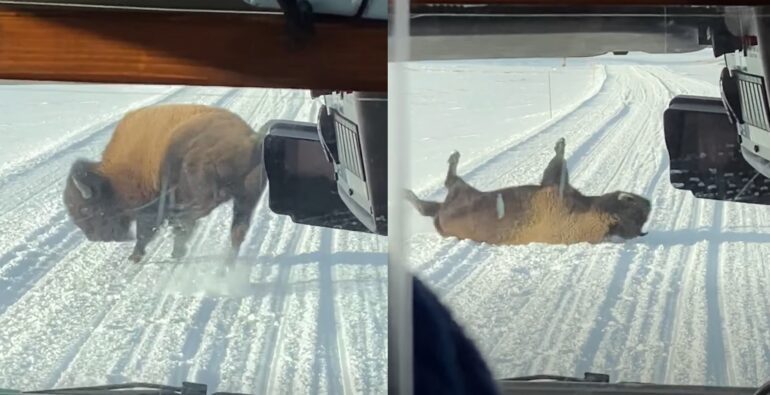
These tourists were out for a ride on a Yellowstone snowcoach and they got to witness it firsthand. They came across a young bison who was having an absolute blast jumping around and rolling in the snow. It jumps up and down into the snow twisting around that seems to say it doesn’t like the vehicle, but it also seems to be pretty playful at the sight of the snow.
The bison stops jumping and immediately hits the ground and rolls to its side as the tourists laugh hysterically at it. It then stands up and doesn’t want to get out of their way as it runs in front of them.
Ol’ boy is having a TIME: