

Hope they at least got a good picture out of it.
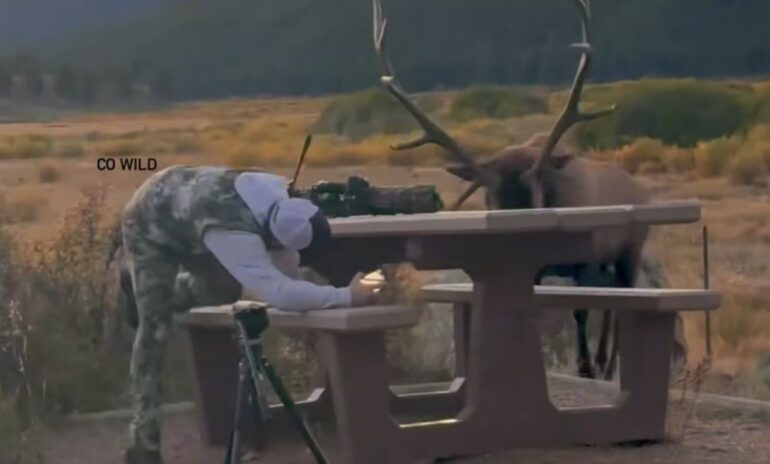
In yet another story of “animals in rut attack,” a wildlife photographer at Rocky Mountain National Park in Colorado was forced to dodge some elk antlers. It looks like they were set up in the perfect spot (in hindsight, maybe a little too perfect) to capture some photos of elk activity when an elk got perturbed and charged.
It’s estimated that over 280,000 elk live in Colorado, which is enough to give the state the honor of housing the largest concentrated population of elk in the world. Believe it or not, that many elk bring in tourists from all over the planet, and one of the more popular places they visit is Estes Park, Colorado – which is referred to as the “Elk Capital of the World.”
Safe to say, if you hang around Estes Park and the surrounding Rocky Mountain area, you are bound to see some elk. And right now, seeing an elk (especially a bull) in person might be a little dangerous.
The elk rut is the annual mating season that occurs from late August through mid-October, during which male elk (bulls) undergo massive hormonal changes to compete for breeding rights. Driven by skyrocketing testosterone levels, bulls focus entirely on gathering and defending large groups of female elk (cows) called harems, often losing up to 20% of their body weight because they are too busy fighting and breeding to eat.
During the rut, a bull elk’s natural flight response is heavily suppressed by aggression, making them highly dangerous and unpredictable.
A hormone-fueled bull views almost any large, moving object that gets too close to his harem as a direct challenger. If a person, dog, or even a vehicle breaches his comfort zone, his immediate instinct is to aggressively drive the threat away.
Bulls are incredibly possessive of their cows during the rut. If a hiker or photographer accidentally walks between a bull and his harem, the bull will almost certainly charge to eliminate the separation and neutralize the threat. Elk rarely attack without warning, but humans frequently misread or ignore the signals. Before a charge, a bull will typically pin his ears back flat against his neck, flare his nostrils, grind his teeth, or aggressively paw the ground.
In high-traffic areas like Yellowstone National Park or Estes Park, Colorado, tourists routinely crowd rutting elk for photos. This constant pressure elevates the animal’s stress levels, eventually causing them to snap and charge simply to clear their personal space.
In this video, the photographer nearly had to dive behind a concrete picnic table to avoid a massive, angry elk that was heading their way with its antlers in attack mode:
“This morning, a bull elk charged a photographer. Thankfully, no one was hurt.. just a good reminder that during rut season, these animals are wild, powerful, and unpredictable.”
Love the elongated bugle there at the end… as if it hadn’t already established itself.
It’s very typical for a post on social media like that to get bombarded with comments condemning the person that got too close to the wildlife. You are typically supposed to stay around 25 yards away from wildlife. That buffer zone stretches out to 100 yards for animals that are deemed more violent, like bears and wolves. So when people see a video of someone closer than the National Park Service advised safe distance, they typically let them hear it.
However, the person who posted that initial video made sure to clear the air and explained that the clip had more to it than meets the eye. In fact, Colorado Wild Photography claimed that they were initially at a safe distance, and it was the elk that got angry (because of some female elk in the area) and approached them:
“This morning, I shared a video of this bull charging a photographer, and I’ve seen some harsh comments calling him names. That’s really unfair. We were a safe distance away, standing by our cars, and no one approached the elk.
What set this bull off was the fact that his cows were inside a fenced enclosure and he couldn’t reach them, he was fired up and frustrated. Wildlife can be unpredictable, and sometimes things happen quickly, even when you’re being careful. A little kindness and understanding go a long way.”
Glad that no one was hurt during the whole ordeal… and as a little bit of a PSA to close, do your best to never be the person in the video being attacked or chased by a wild animal.